
Contents
- How do you read the care label on a teddy bear?
- Which way of washing suits your soft toy?
- Can you put a teddy bear in the washing machine?
- Does washing a teddy at 40 °C kill dust mites?
- How do you wash a teddy bear by hand?
- How do you clean a teddy bear without washing it?
- Big, weighted, battery or vintage teddy: what is different?
- How do you dry a teddy bear properly?
- How often should you wash a soft toy?
- How do you wash a comfort toy without upsetting your child?
- Teddy bear washing: your questions answered
- Sources
How to wash a teddy bear depends first on its label. Machine washable? Tie it in a pillowcase, choose a delicate cycle at the temperature shown and a low spin, then dry it flat. Hand wash only? Lukewarm water in a basin. No washing at all? Foam or bread soda on the surface. Battery, weighted and vintage bears each need their own method.
A teddy that goes everywhere, from the cot to the crèche to the back seat of the car, gets grubby fast. Most come through a wash looking better than before, as long as you know what is inside them.
How do you read the care label on a teddy bear?
The label sewn into a seam carries the GINETEX care symbols used on clothes sold in Ireland and across the EU, always in the same order.
| Symbol | What it means | For your soft toy |
|---|---|---|
| Washtub with a number | Machine washable, maximum temperature in degrees Celsius | Never go above that number, even for a stain |
| One or two bars under the tub | Gentle cycle, then very gentle cycle | Two bars: wool or delicates programme, lowest spin |
| Washtub with a hand | Hand wash only | Lukewarm water in a basin, no machine |
| Crossed-out washtub | Do not wash in water | Surface or dry cleaning only |
| Crossed-out triangle | No bleach | No bleach at all, not even on a stain |
| Square with a circle | Tumble drying allowed, one dot for low heat | Without this symbol, air dry |
| Circle on its own | Professional cleaning | Dry cleaner, showing them the label |
If one of our teddy bears has joined the family, its own label tells you which of the methods below applies. No label at all? Treat the toy as the most delicate thing in the house: hand wash or surface clean only. The European toy safety standard, EN 71, which goes with the CE mark, says nothing about how to wash a toy.
Whatever the label says, test a hidden spot under an arm with damp cotton wool and a drop of detergent. Colour on the cotton means no soaking.
Which way of washing suits your soft toy?
A teddy is not a jumper: under the fur there may be fibre, beads, a battery unit or sixty-year-old wood wool.
| Type of soft toy | Method | Drying | Watch out for |
|---|---|---|---|
| Standard teddy, fibre filling, machine-wash label | Machine, delicate cycle, inside a pillowcase, at the label temperature | Flat, in the open air | Seams, glued eyes and nose |
| Baby’s comforter | Machine if the label allows, otherwise by hand, with an extra rinse | Air dry, turned regularly | No fragrance, no detergent left behind |
| Battery toy: musical, breathing, night light | Remove the unit, then wash the cover as labelled; sewn-in unit: surface only | Dry right through before refitting the unit | Batteries stored out of reach |
| Weighted soft toy | Remove the weight pouch if it comes out; sewn-in weight: by hand or surface | Flat, often two days | Weight of the water, seams pulling |
| Giant teddy | Vacuum, bicarbonate of soda, foam on the most handled areas | In place, in an airy room | Stuffing that never dries to the core |
| Vintage or collector’s bear | Gentle vacuum, brushing, barely damp cloth | Almost no water, so almost no drying | Wood wool, mohair, voice box |
| Sequinned toy or toy with glued parts | By hand or surface, cold to lukewarm water | Flat | Glue giving way, sequins catching |
| Soft toy with no label | Hidden test, then by hand or surface | Flat | Colours running |
Can you put a teddy bear in the washing machine?
If the label shows a washtub with a number, yes, and the machine is the easiest way. Check the bear first: a seam that gapes going in comes out wide open. Sew it up, and our guide on how to repair a stuffed toy shows the stitches that hold. Remove clothes and accessories too.
Teddy in the washing machine, in five steps
A closed pillowcase
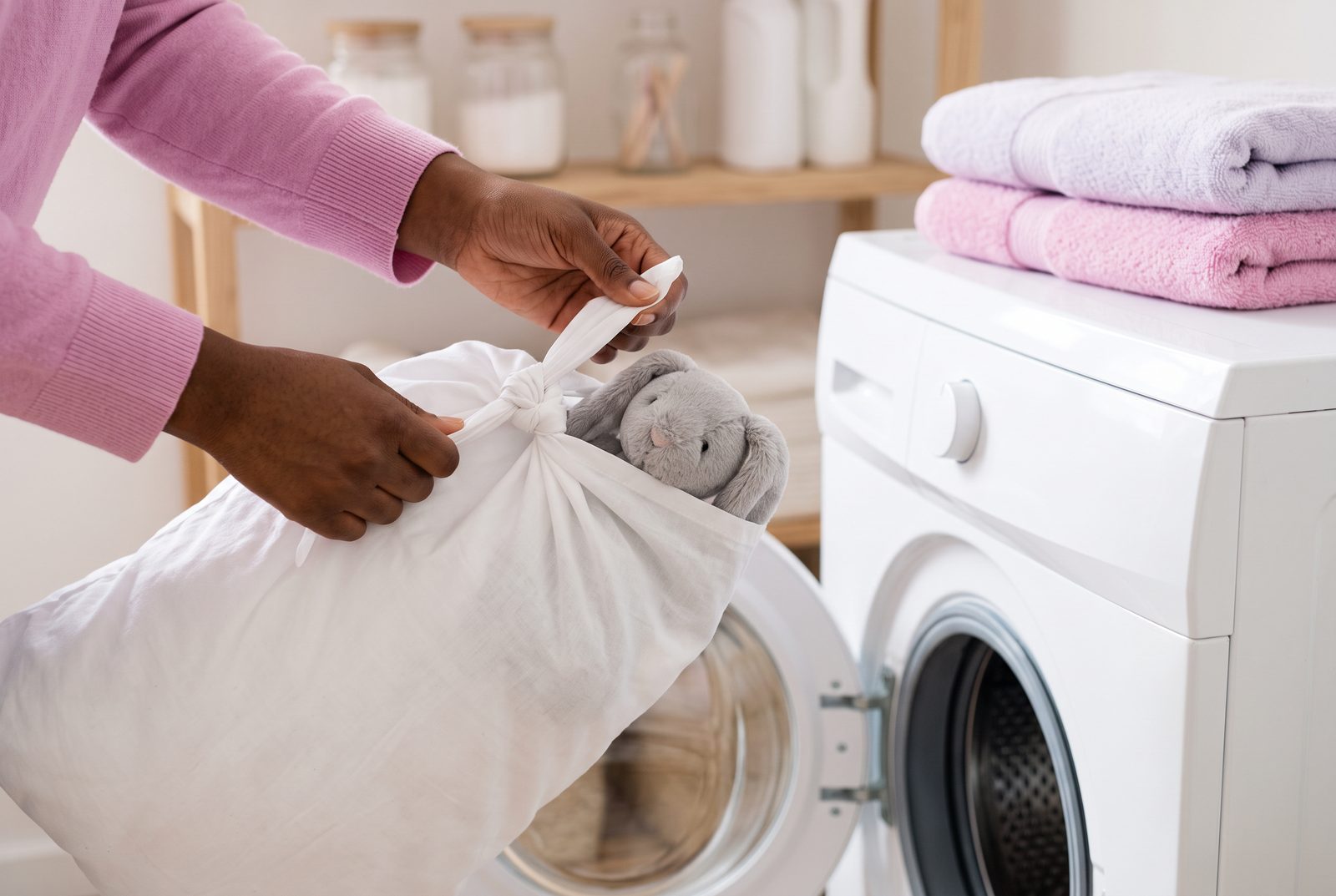
Slip the toy into a pillowcase tied in a knot, or a mesh laundry bag, so the fur, eyes and seams stop rubbing against the drum.
A few towels
Two or three towels in a similar colour keep the drum balanced on the spin.
A small dose of gentle detergent
Liquid detergent for delicates, in a small amount. Powder dissolves poorly at low temperatures and leaves traces in the fur.
The delicate cycle
Delicates or wool, at the label temperature, with a spin of around 400 to 600 rpm.
One extra rinse
It carries away leftover detergent, and a good share of the allergens with it.
Skip fabric conditioner: it leaves a film on the fibres, and a well-rinsed toy brushed once dry is soft again without it.
Does washing a teddy at 40 °C kill dust mites?
In one study, all 40 children’s soft toys tested contained dust mite allergens, at levels around three times higher than on mattresses (Wu et al., 2014).
Lukewarm water barely kills dust mites. In a washing machine, only 6.5 % of mites died at 30 °C and 9.6 % at 40 °C; at 60 °C, every one did (Choi et al., 2008). An older study puts the threshold at 55 °C (McDonald and Tovey, 1992).
Share of dust mites killed by wash temperature
Should everything go in at 60 °C, then? No. What also matters is how much allergen is left in the fabric, and there water works even when cold. A cold wash removed more than 90 % of the allergens from bedding without killing the mites (McDonald and Tovey, 1992). In the other study, 26.8 % remained after a 30 °C wash and 2.4 % after a 40 °C wash, and the number of rinses made a difference too (Choi et al., 2008).
Hence the rule: the label’s top temperature, one extra rinse, frequent rather than scalding washes. Dry cleaning killed the mites without lowering the allergens (McDonald and Tovey, 1992). None of our sources measured the freezer trick, so follow it with a wash. Child with an allergy? Ask your GP how often to wash.
How do you wash a teddy bear by hand?
For a toy marked with a hand in the washtub, or one that has lost its label, allow 20 minutes and a basin or the kitchen sink.
Use lukewarm water, around 30 °C, and a teaspoon of detergent for delicates. Squeeze the toy gently under the water several times so it moves through the stuffing, without rubbing against the pile. Soak for 15 minutes, less if the colours are bright.
Rinse, changing the water two or three times, until it no longer foams. Never wring it out, or the fibre clumps and the seams split. Roll it in a dry towel, press hard, repeat with a second one.
How do you clean a teddy bear without washing it?
Crossed-out washtub, sewn-in unit, too big for the drum: three methods, to combine.
Surface cleaning
Whisk lukewarm water and mild soap into a foam and use only the foam, on a flannel. Rub small areas along the pile, rinse with a second flannel in clean water, blot with a third, dry one. The fur comes clean, the stuffing stays dry.
Bread soda, dry
Put the toy in a large bag with two or three tablespoons of bread soda (bicarbonate of soda), close it and shake for a good minute. Leave it a few hours, overnight for a stubborn smell, then shake the toy outside and vacuum it on low power with the brush attachment. Bread soda absorbs smells, but it does not wash.
Stains
On a fresh stain, dab with a damp cloth and a little plain, unscented bar soap. A greasy mark, such as cream or chocolate, responds to Fuller’s earth: sprinkle it on, leave it for several hours, then brush it off. Keep bleach and surgical spirit away, as both can fade synthetic fibres.
Sequinned and flip toys are cleaned on the surface, without soaking, and our article on the reversible octopus plush covers how to look after one.
Big, weighted, battery or vintage teddy: what is different?
The big teddy
Soaked through, a big teddy, say one taller than 100 cm, would take days to dry, so it is cleaned where it sits: vacuum the whole surface, leave bread soda on overnight, then use foam on the areas people touch most, paws, muzzle and tummy. A vacuum every few weeks keeps it fresh.
The weighted soft toy
A weighted soft toy holds glass beads or plastic pellets, sometimes in a pouch that comes out through a zip. Take it out and wash the cover according to its label. Weight sewn in? No machine unless the label says otherwise: soaked with water, the toy pulls on its seams and unbalances the drum. Wash it by hand or on the surface and allow two days of flat drying.
The battery toy: musical, breathing, night light
The electronic unit never goes in water. Take the unit out through its opening, often a flap under the tummy, keep the batteries out of children’s reach, then wash the cover as labelled. Unit sewn in? Surface clean only, with a barely damp flannel. Wait until everything is dry to the core before putting the mechanism back, for a music box as for a breathing plush.
The vintage or collector’s bear
A 1950s bear may hide mohair, wood wool, kapok, glass eyes or a voice box. Water makes wood wool swell, rusts metal joints and leaves tide marks. Vacuum on the lowest setting with nylon tights over the nozzle, brush gently, wipe with a barely damp cloth, and take a valuable piece to a restorer. Our guide on how to clean an old teddy bear goes through every step.
How do you dry a teddy bear properly?
Drying spoils more soft toys than washing does: stuffing left damp in the middle soon smells musty. Lay the toy flat on a towel, on a clothes horse in a well-ventilated room or outside in the shade: daylight yes, strong sun no. Turn and shake it every two or three hours, and keep it off the radiator, which hardens synthetic fur.
Irish air is rarely dry, and in winter most drying happens indoors: allow 24 hours for a small teddy and two to three days for a large one. Nearly dry, it can finish on a hot press shelf, away from the tank and pipes. Squeeze the tummy firmly: if it still feels cool inside, wait.
What about the tumble dryer?
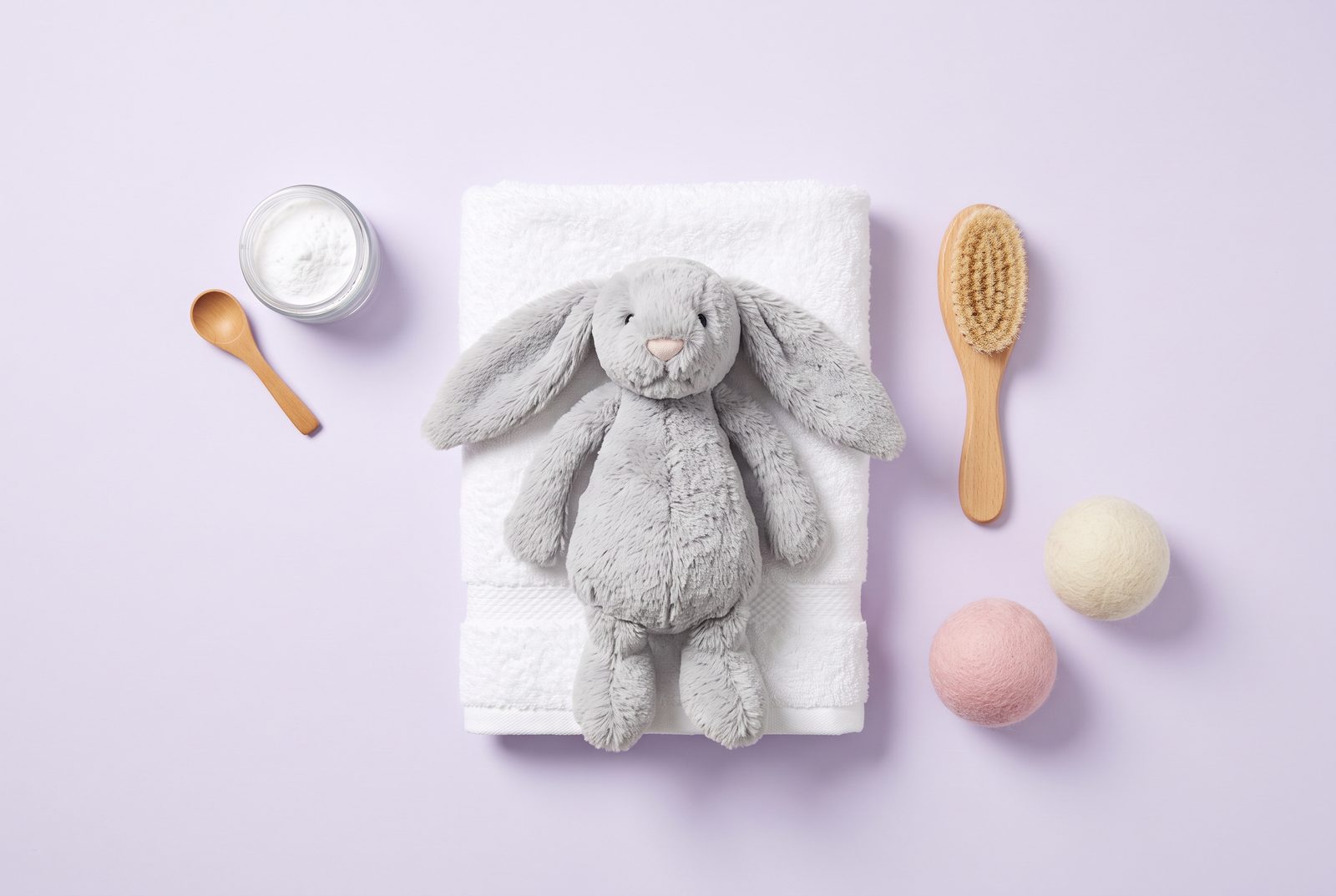
Only if the label shows the square with a circle, and on low heat, one dot. Add two dryer balls and take the toy out while it is still slightly damp, to finish in the air. High heat frizzes synthetic fur and can warp plastic eyes or weight pellets.
How often should you wash a soft toy?
Dust mite allergens settle quickly in a new soft toy. The study that measured this also found that washing with detergent brought them down markedly, while vacuuming did not (Nagakura et al., 1996).
The time it took for the dust mite allergens in a new soft toy to rise 10 to 20 times.
Nagakura et al., 1996, Clinical & Experimental Allergy
For the comfort toy that sleeps in the bed, about once a month is a good rhythm, more often if it goes to the crèche. Wash it at once after an illness, sickness or a fall in the mud. A shelf toy needs a wash two or three times a year.
How do you wash a comfort toy without upsetting your child?
To a toddler, a comfort toy is not like other toys. Children who were led to believe a machine could copy their belongings exactly were far less willing to accept a copy of their attachment object than a copy of their favourite toy (Hood and Bloom, 2008). Your child wants that particular teddy.
If you buy a spare, rotate the two from the start so that each becomes “the” teddy; one introduced later is often shunned.
Otherwise, pick your moment: wash it in the morning while your child is at the crèche or the childminder’s, dry it during the day, back in bed by the evening. Or let your child join in: teddy is having a bath, just like them. For a baby who chews it, no fragrance, no essential oils, a careful rinse. What this object means at each age is explained in our article on why a comfort blanket matters to a child.
Teddy bear washing: your questions answered
How do you disinfect a teddy bear?
For everyday care there is no need for a disinfectant. Wash the teddy at the highest temperature its label allows, add a rinse and dry it right through. After a tummy bug, wash it straight away. Bleach is ruled out by most labels and fades synthetic fur.
How do you make an old teddy look new again?
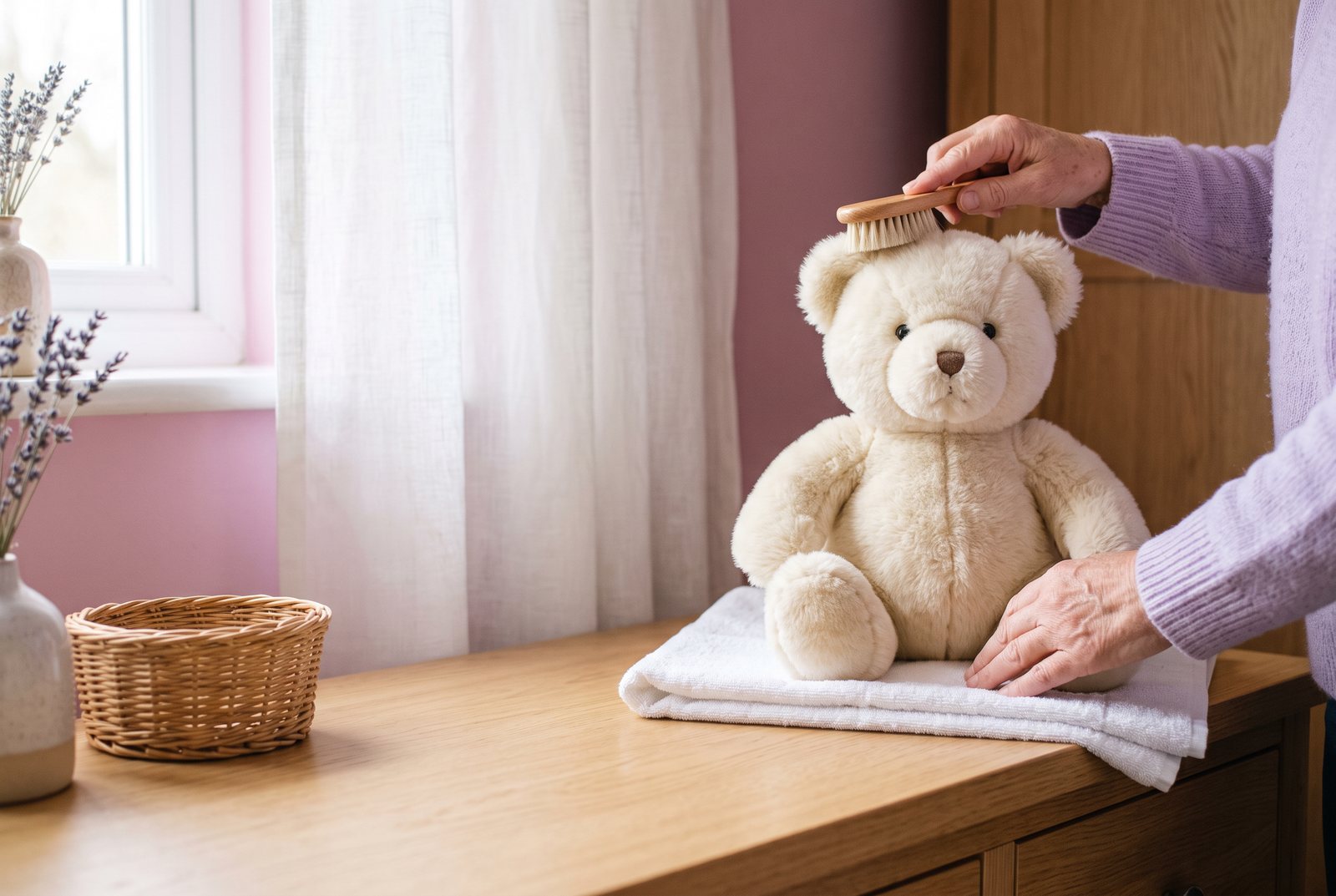
Brush the fur in the direction of the pile with a soft hairbrush once it is clean and dry, then plump the stuffing by squeezing and shaking the body. Flattened areas often hide clumped fibre: tease it apart through the fur, or open a seam and top it up with new stuffing.
Can you wash a teddy bear with washing-up liquid?
For a spot clean, yes: a drop of mild washing-up liquid whisked into lukewarm water, using only the foam on a cloth. Keep it out of the washing machine, where it foams far too much. For a full wash, a little liquid detergent for delicates rinses out more easily.
Do you need to wash a new teddy before a baby gets it?
No, it is not a must. One study measured almost no dust mite allergen in new soft toys, about 0.1 µg per gram of dust, against 9 after a year of use. If you would rather wash it, follow its label and rinse well, as babies often chew their teddies.
Sources
Choi S.Y., Lee I.Y., Sohn J.H., Lee Y.W., Shin Y.S., Yong T.S., Hong C.S., Park J.W. (2008). Optimal conditions for the removal of house dust mite, dog dander, and pollen allergens using mechanical laundry. Annals of Allergy, Asthma & Immunology, 100(6), 583-588. DOI: 10.1016/S1081-1206(10)60060-9
Hood B., Bloom P. (2008). Children prefer certain individuals over perfect duplicates. Cognition, 106(1), 455-462. DOI: 10.1016/j.cognition.2007.01.012
McDonald L.G., Tovey E. (1992). The role of water temperature and laundry procedures in reducing house dust mite populations and allergen content of bedding. Journal of Allergy and Clinical Immunology, 90(4), 599-608. DOI: 10.1016/0091-6749(92)90132-L
Nagakura T., Yasueda H., Obata T., Kanmuri M., Masaki T., Ihara N., Maekawa K. (1996). Major Dermatophagoides mite allergen, Der 1, in soft toys. Clinical & Experimental Allergy, 26(5), 585-589. DOI: 10.1111/j.1365-2222.1996.tb00580.x
Wu F.F., Wu M.W., Ting M.H., Crane J., Siebers R. (2014). Cat, dog and house dust mite allergen levels on children’s soft toys. Journal of Asthma, 51(1), 75-78. DOI: 10.3109/02770903.2013.843097