

Contents
- Where does the teddy bear come from?
- What is Ireland’s link with the teddy bear?
- How has the teddy bear changed in 120 years?
- Why do we get so attached to our teddy bears?
- What kinds of teddy bears can you find today?
- How do you choose a teddy bear by age?
- How can you tell if a teddy bear is old?
- How do you make a teddy bear last?
- Your questions about the teddy bear
- Sources
The teddy bear origin story is half American, half German. In November 1902, President Theodore “Teddy” Roosevelt refused to shoot a bear tied to a tree, a cartoon made the story famous, and a Brooklyn couple sold a toy “Teddy’s bear”. Within months, a German workshop presented the first fully jointed mohair bear.
Ireland has its own small part in the tale. The words of The Teddy Bears’ Picnic, still sung in crèches and national schools, were written by a man born in Omagh in 1902, the same year as the teddy. Here is the real story, how the bear has changed, why we keep ours for life and how to choose one today.
Where does the teddy bear come from?
Two countries claim its birth, and both are right. Toy historians speak of a double invention a few months apart, with no known link between the two.
A hunt in Mississippi, November 1902
Theodore Roosevelt, President of the United States and a keen hunter, was invited on a bear hunt in Mississippi. The day turned up nothing. To give him a trophy, his guides tied an exhausted captured bear to a tree and invited him to shoot it. He refused: killing a tethered animal was not sport.
On 16 November 1902, the cartoonist Clifford Berryman drew the scene for the Washington Post. In that cartoon and the many that followed, the bear shrank into a round little cub with big eyes, far more endearing than the real animal. The public loved it.
A Brooklyn couple and “Teddy’s bear”
In Brooklyn, Morris Michtom, a Russian immigrant, ran a small sweet and toy shop with his wife Rose, who sewed fabric dolls. They saw the cartoon, and Rose stitched a little bear that went into the window as “Teddy’s bear”. According to the family story, Roosevelt agreed to the use of his nickname. By 1903 orders were pouring in and the couple founded a toy company.
In Germany, the first jointed bear
In Giengen an der Brenz, a small town about 100 km from Stuttgart, a seamstress who had had polio as a child ran a felt-toy workshop. Her nephew, who sketched bears at Stuttgart zoo, persuaded her in 1902 to make one in mohair, with arms and legs that moved. That was the real novelty: until then, fabric animals stayed stiff.
The bear was shown at the Leipzig toy fair in spring 1903, and an American buyer ordered 3,000 of them. Historians think it very unlikely that the German workshop knew about the Roosevelt story at the time: two parallel inventions, then, brought together by the name teddy bear.
| Date | What happened | Where |
|---|---|---|
| November 1902 | Roosevelt refuses to shoot a tied bear; the cartoon appears on the 16th | Mississippi, then Washington |
| 1902 | First design for a mohair bear with jointed limbs | Giengen an der Brenz, Germany |
| 1903 | The Michtoms’ “Teddy’s bear” in the shop window; the German bear shown at Leipzig | Brooklyn; Leipzig |
| 1907 | The tune of The Teddy Bears’ Picnic is written as an instrumental by John W. Bratton | United States |
| 1914 to 1918 | German toy imports stop in Britain and Ireland during the war | Britain and Ireland |
| 1932 | Jimmy Kennedy, born in Omagh, County Tyrone, writes the lyrics of The Teddy Bears’ Picnic | Ireland and Britain |
| After 1945 | The bear grows rounder and softer, and becomes a comforter | Europe, United States |
| 1984 | Opening of the first museum devoted to teddy bears | Petersfield, England |
| From 2000 | Teddy Bear Hospitals, run by medical students, begin in Norway, then spread to Irish universities | Norway; Cork, Limerick, Galway |
What is Ireland’s link with the teddy bear?
Ireland did not invent the teddy, but it gave the bear its most famous song. The tune of The Teddy Bears’ Picnic was composed in America in 1907 by John W. Bratton, as an instrumental with no words. In 1932 Jimmy Kennedy, a songwriter born in Omagh, County Tyrone, on 20 July 1902, set lyrics to it. The song about bears gathering in the woods for a secret feast became one of the best-loved children’s songs in these islands.
It lives on in an Irish summer habit: the teddy bears’ picnic, where every child brings a bear, held by crèches, libraries, parish groups and fundraising days up and down the country. If your little one is getting ready for one, a sturdy, medium-sized bear travels best, and our range of teddy bears runs from pocket cubs to picnic companions.
Teddy Bear Hospitals in Irish universities
The other Irish tradition is younger. Teddy Bear Hospitals began in Norway in 2000 and are now run by medical students at Irish universities, including UCC in Cork, the University of Limerick and the University of Galway. Children bring a “sick” teddy, and student “teddy doctors” examine it, bandage it and explain what they are doing. The aim is to make a visit to the doctor or the hospital feel less frightening, with the bear going through the check-up first.
It says a lot about the teddy that it works so well in that role. A child will happily let a stranger listen to their bear’s heartbeat long before they would let anyone near their own.
How has the teddy bear changed in 120 years?
Put a 1905 bear next to a modern teddy and they look like two different animals. The first was a heavy toy with coarse fur, a long snout, a hump on its back and arms that reached almost to its knees. Large bears of that period measured 45 to 75 cm, roughly 18 to 30 inches.
| Feature | Early bears (1903 to 1940) | Today’s teddies |
|---|---|---|
| Fur | Mohair, woven from angora goat hair, fairly coarse | Very soft synthetic plush, short or long pile |
| Stuffing | Wood wool (excelsior), packed hard | Light polyester fibre, sometimes pellets for weight |
| Eyes | Boot buttons, then glass eyes from around 1910 | Embroidered, or plastic safety eyes fixed from inside |
| Shape | Long snout, humped back, long arms, flat feet | Round head, big tummy, short limbs |
| Joints | Discs inside the shoulders, hips and neck | Often none: a soft body that bends |
| Care | Barely any water; brushing and gentle vacuuming | Washed as the label says, often in the machine |
The big turning point came after the Second World War. The bear grew soft, round and smaller, and moved from the shelf into the bed. That is when it took on the comforter role we know today.
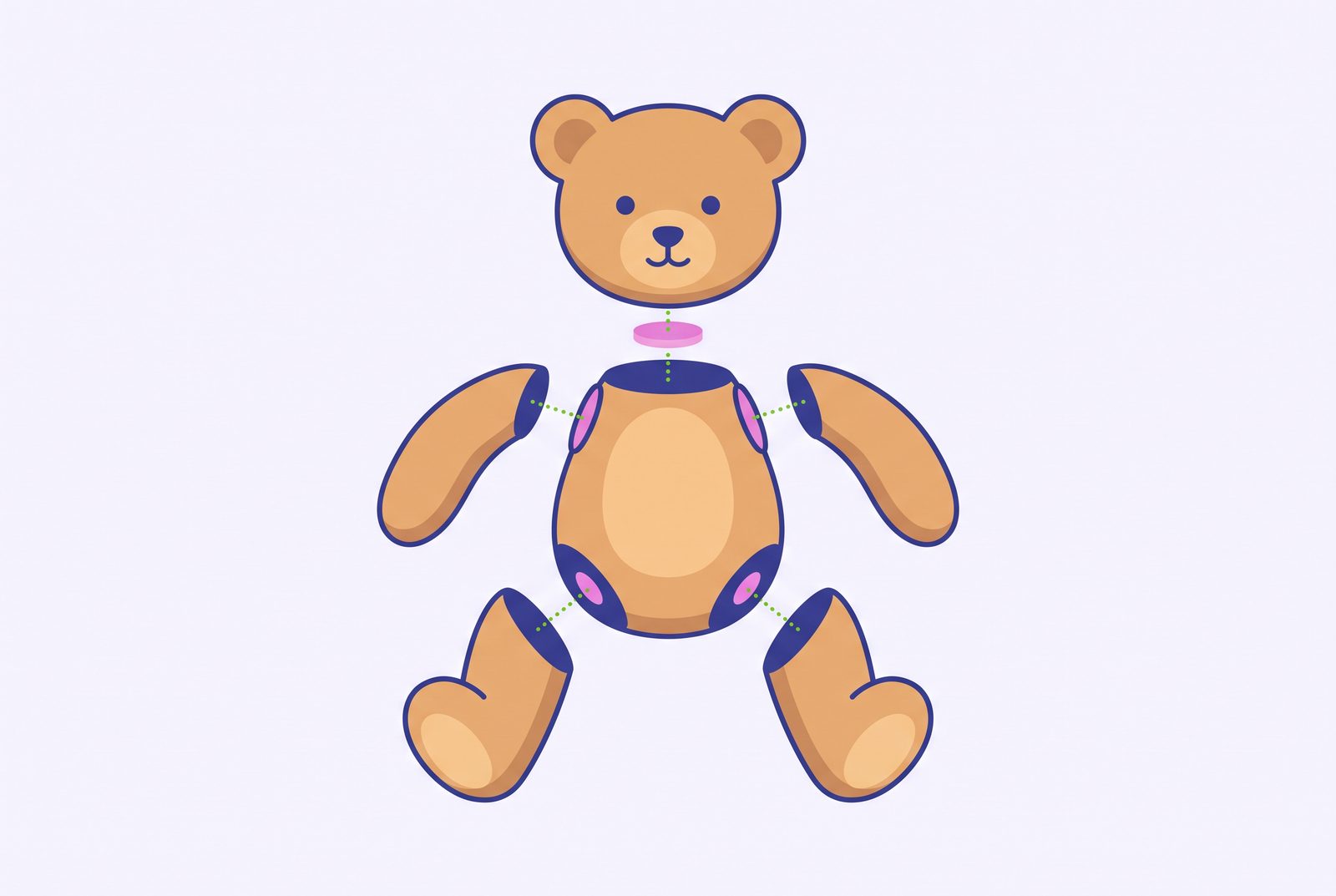
The modern recipe has not wiped out the old one. Jointed bears are still made, in mohair or synthetic fur, for anyone who likes to pose them, cross their arms or tilt their head.
Why do we get so attached to our teddy bears?
In 1953 the English paediatrician and psychoanalyst Donald Winnicott gave a name to the blankets, scraps of fabric and soft toys young children will not be parted from: the transitional object. Researchers who followed him see it as a help on the road to independence, with a role that changes as the child grows (Litt, 1986).
That attachment is not only about temperament. In 1,122 pairs of 3-year-old twins, attachment to an object was explained 48% by heredity and 48% by the shared family environment. Children who spent full days in a crèche were more often attached to an object than those who went for half days (Fortuna et al., 2014). What that companion means at each age is explored in our article on why a comforter matters to a child.
And it is never just any bear. In one experiment, children who believed a machine could copy their belongings exactly were far less willing to accept a copy of their attachment object than a copy of a favourite toy (Hood and Bloom, 2008). Yours has a history, a smell, a slightly worn ear: it is the one.
The bond does not always end in early childhood. A Finnish survey of 1,054 secondary school pupils with an average age of 14.5 years found that 29% still kept such an object, girls twice as often as boys (Erkolahti and Nyström, 2009).
Pupils who still keep an attachment object, at 14.5 years
No wonder a childhood teddy follows its owner to the Gaeltacht, to college digs or into a first home.
What kinds of teddy bears can you find today?
The same animal comes in a handful of families, each with its own job, from the little cub that fits in one hand to the companion that takes over an armchair.
The comforter bear
Floppy, light, no hard parts. It slips into a bag and can be held in one hand.
The classic bear
Sitting or jointed, firmer. It lives on a shelf and is kept for years.
The bear with a job
Weighted, night light, musical or hot water bottle: it does more than cuddle.
The giant bear
Over a metre tall, a bear becomes furniture. You lean on it to read and squeeze it like a cushion. Before choosing from our giant plush range, measure the space and think about cleaning: a bear that size will not fit in the washing machine and is cleaned where it sits. With a young child it stays on the floor or in a corner of the room, never in the bed: fine for snuggling into for a story, not for sleeping under. A teenager will happily turn it into a sofa backrest.
The dressed-up bear
Pilot, doctor, groom, pyjamas or a Christmas jumper: the outfit says something about the person giving it. A teddy bear in disguise can mark a job, a passion or a big day, from a first day at school to a retirement. For a toddler, check that any accessories are sewn on, not just slipped on.
Weighted, night-light and musical bears
Weighted bears hold pellets that give them heft, for people who like a gentle pressure against them. Night-light bears give off a soft glow, musical bears play a lullaby, and hot water bottle bears keep a warm pouch that you heat exactly as the instructions say, never more. These models have batteries or an insert: read their product page and minimum age, and make sure the battery compartment stays closed, ideally with a screw.
How do you choose a teddy bear by age?
Start with the label. Every toy sold in Ireland and the rest of the European Union must carry the CE mark, and most makers rely on the EN 71 standard to show they are safe. The round, crossed-out symbol with a baby’s face and “0-3” means “not suitable for children under 36 months”: it warns of small parts that could come loose.
From baby’s cuddle to collector’s shelf
For a baby, go for a bear of 20 to 30 cm that small hands can grab, with stitched eyes and nose rather than glued or clipped ones, and no long shedding fur or ribbon round the neck. For sleep, the HSE advises keeping pillows, duvets, bumpers, toys and teddies out of a baby’s cot. The bear waits nearby for awake time.
Before you look at colours, ask yourself three things. Who will hug it, and at what age? Where will it live: in bed, in a schoolbag, on a shelf? And how will it be washed the day it lands in a puddle? Your answers rule out half the bears on offer. If you ever wonder whether a toy has been recalled, the Competition and Consumer Protection Commission (CCPC), Ireland’s contact point for the EU Safety Gate alert system, publishes product recalls that concern Irish shoppers.
Between 3 and 10 years, the bear goes to school, to the park, on holidays to Granny’s. It has to cope: tug gently on an ear and a paw and check that no seam gapes. A label that allows machine washing will make your life easier. To judge the finish at a glance, see how to recognise a good-quality soft toy.
Adults are given bears for a birth, a christening, Valentine’s Day, a going-away or a loss. Here fabric matters more than size: dense fur, stuffing that springs back when pressed, an expressive face. If the person likes to display a bear, a jointed one sits better than a floppy one. Colour carries your message too: brown and honey recall the bear of childhood, white and cream suit births and weddings, red and pink suit declarations.
How can you tell if a teddy bear is old?
Collecting bears has its own name, arctophily. Some collectors only want antique bears, others artist bears, hand-sewn in small numbers.
A bear from the first half of the 20th century shows several clues at once: mohair fur often worn at the paws, stuffing that crunches slightly when pressed, a sign of wood wool, glass or boot-button eyes, disc joints, a humped back and a long snout. A single clue proves nothing; the combination does.
An old bear never goes in water: wood wool swells, metal discs rust and mohair keeps watermarks. To dust it safely, follow our method to clean an old teddy bear. To value a piece, see a specialist or an auction house, never a listing.
How do you make a teddy bear last?
A loved bear wears out first where it is held: under the arms, the tip of the snout, the back of the neck. Three habits keep it going for years.
Brush it once a month with a soft brush, with the pile, to lift the fur. Restitch a seam as soon as it opens, before the stuffing escapes. And wash a modern bear as its label says, inside a closed pillowcase, at the temperature shown: our guide to washing a stuffed toy covers machine, hand and dry cleaning, and drying right through.
Has your bear lost an eye? For a young child, do not glue a bead back on: embroider an eye in thick thread, in tight satin stitch. It will not come off again, and the face keeps its expression. Keep the original eye in an envelope if the bear has sentimental value. Store it away from radiators and strong sun, which fade colours and harden synthetic fur, and pack it in a cloth bag rather than squashed at the bottom of a suitcase when it goes on holidays.
Your questions about the teddy bear
What does a teddy bear symbolise?
Comfort and protection: an animal known for its strength, made soft and harmless. Given at a birth or a christening, it says welcome; given to an adult, it says tenderness or remembrance. For a child it is often a confidant, the friend who hears about the day at school and gets a squeeze when the lights go off.
How much is an old teddy bear worth?
It depends on age, maker, condition and history. A well-loved bear from the 1950s may be worth more to the family than at auction, while an early jointed mohair bear in good condition can fetch a great deal. Only a specialist valuer or an auction house can judge a piece properly, never an online listing.
When is Teddy Bear Day?
In the United States, National Teddy Bear Day falls on 9 September. It is not an official date in Ireland, but libraries, crèches and children’s wards sometimes hold bear days of their own, and summer brings plenty of teddy bears’ picnics. Either is a good excuse to tell the story of Roosevelt and the spared bear.
Who are the most famous teddy bears?
Winnie-the-Pooh tops most lists: he was based on a bear given to Christopher Robin Milne in London in 1921 and named after Winnipeg, a black bear at London Zoo. Paddington and Rupert are cartoon bears rather than teddies but just as loved. For most people, though, the most famous bear is the one they had as a child.
Sources
Erkolahti R., Nyström M. (2009). The prevalence of transitional object use in adolescence: is there a connection between the existence of a transitional object and depressive symptoms? European Child & Adolescent Psychiatry, 18(7), 400-406. DOI: 10.1007/s00787-009-0747-7
Fortuna K., Baor L., Israel S., Abadi A., Knafo A. (2014). Attachment to inanimate objects and early childcare: A twin study. Frontiers in Psychology, 5, 486. DOI: 10.3389/fpsyg.2014.00486
Hood B., Bloom P. (2008). Children prefer certain individuals over perfect duplicates. Cognition, 106(1), 455-462. DOI: 10.1016/j.cognition.2007.01.012
Litt C.J. (1986). Theories of transitional object attachment: An overview. International Journal of Behavioral Development, 9(3), 383-399. DOI: 10.1177/016502548600900308