
Contents
- What makes a soft toy good quality?
- What do the CE mark and EN 71 guarantee in Ireland?
- How can you tell a soft toy is well made?
- Which soft toy suits which age?
- Comforter or teddy: which is better for a baby?
- Is there a soft toy for boys and one for girls?
- Which fabric and stuffing should you choose?
- Battery, weighted or giant soft toys: what precautions?
- Quality soft toys: frequently asked questions
- Sources
Quality soft toys share three things. A complete label, with the CE mark, a minimum age, the maker’s name and address and care advice. A solid build: eyes embroidered or firmly fixed, tight seams, fur that stays put when pulled. And a size and fabric that suit the child’s age, with nothing that can come off before 3.
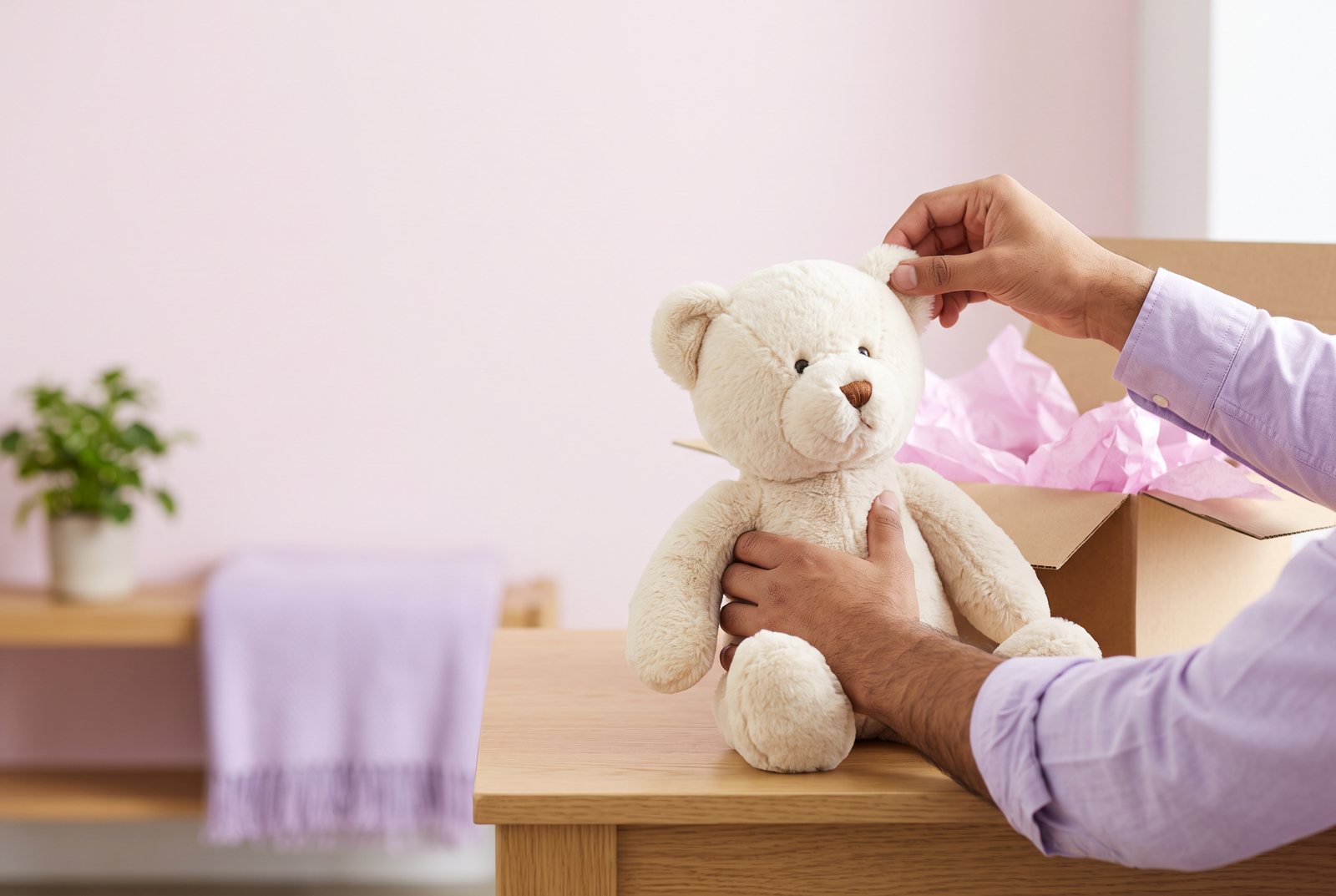
Online, every teddy looks soft, and a toy bought for Christmas or a christening is usually unwrapped by someone else. So the check happens on the day the parcel arrives, in under 60 seconds. Here is what to look at, age by age, and what the logos really mean.
What makes a soft toy good quality?
Neither the price nor the name on the tag. A good quality soft toy meets five demands at once, and the first one is not up for negotiation.
Five things every quality soft toy gets right
soft toy
Safe
Meets the toy safety rules, with no small detachable parts for children under 3.
Sturdy
Tight seams, eyes and nose that resist a pull, fur that stays in place.
Soft
A fabric that feels good against the cheek, with no chemical smell when you open the parcel.
Washable
A readable care label, ideally one that allows the washing machine.
Right for the job
A size and weight that suit the age and the use: cuddles, bedtime or display.
The rest, the animal, the colour, the character, is a matter of taste. It matters enormously to the child, and we come back to it further down.
What do the CE mark and EN 71 guarantee in Ireland?
In law, a soft toy is a toy. In Ireland it comes under the EU Toy Safety Directive, given effect by SI 14/2011, and it must carry the CE mark. The CCPC, which polices toy safety here, puts it simply: if the toy does not have one, do not buy it. Still, the logo is not a quality label. The maker affixes it, declaring that the product meets the safety rules, and usually relies on the EN 71 series of standards to prove it.
| On the label | What it means | What it does not say |
|---|---|---|
| CE mark | The maker declares that the toy meets the safety requirements | Neither an independent test nor a promise of how long it lasts |
| EN 71-1 | Mechanical and physical properties: small parts, seams, pull resistance | Nothing about softness or how it survives washing |
| EN 71-2 | How the materials behave near a flame | It is still a textile: keep it away from candles and heaters |
| EN 71-3 | Migration of certain chemical elements, such as lead | Does not cover every substance in a fabric |
| Crossed-out 0 to 3 symbol | Not suitable for children under 36 months, because of small parts | Does not mean the toy is fragile: it is meant for an older child |
| GS | German mark awarded after tests by an independent body | Optional, missing from many perfectly safe soft toys |
| OEKO-TEX Standard 100 | Textile tested for a list of unwanted substances | Nothing about sturdiness or small parts |
| GOTS | Organic fibres and textile production rules | Does not replace toy safety standards |
The label must also give the name and address of the maker or importer, plus a model or batch number: that is how the toy is traced if it is recalled. The CCPC also warns that some packaging carries a forged CE symbol, which is why the other checks below matter. Its inspections are not a formality: in October 2025 it reported that over 25,000 unsafe toys had been removed from the Irish market in a single year.
The same goes for a toy from a market stall, a pop-up stand or a second-hand sale: no mark and no address, and it stays out of a toddler’s arms.
How can you tell a soft toy is well made?
The standard sets a minimum. Your hands do the rest, before the wrapping paper goes on.
Eyes and nose
Pinch each eye and pull firmly. Eyes embroidered in thread cannot be torn off, which makes them the safest for a baby. Plastic safety eyes, locked by a washer inside the head, hold well too. An eye that is only glued on does not. Do the same test on the nose, buttons, ribbons and bells.
Seams
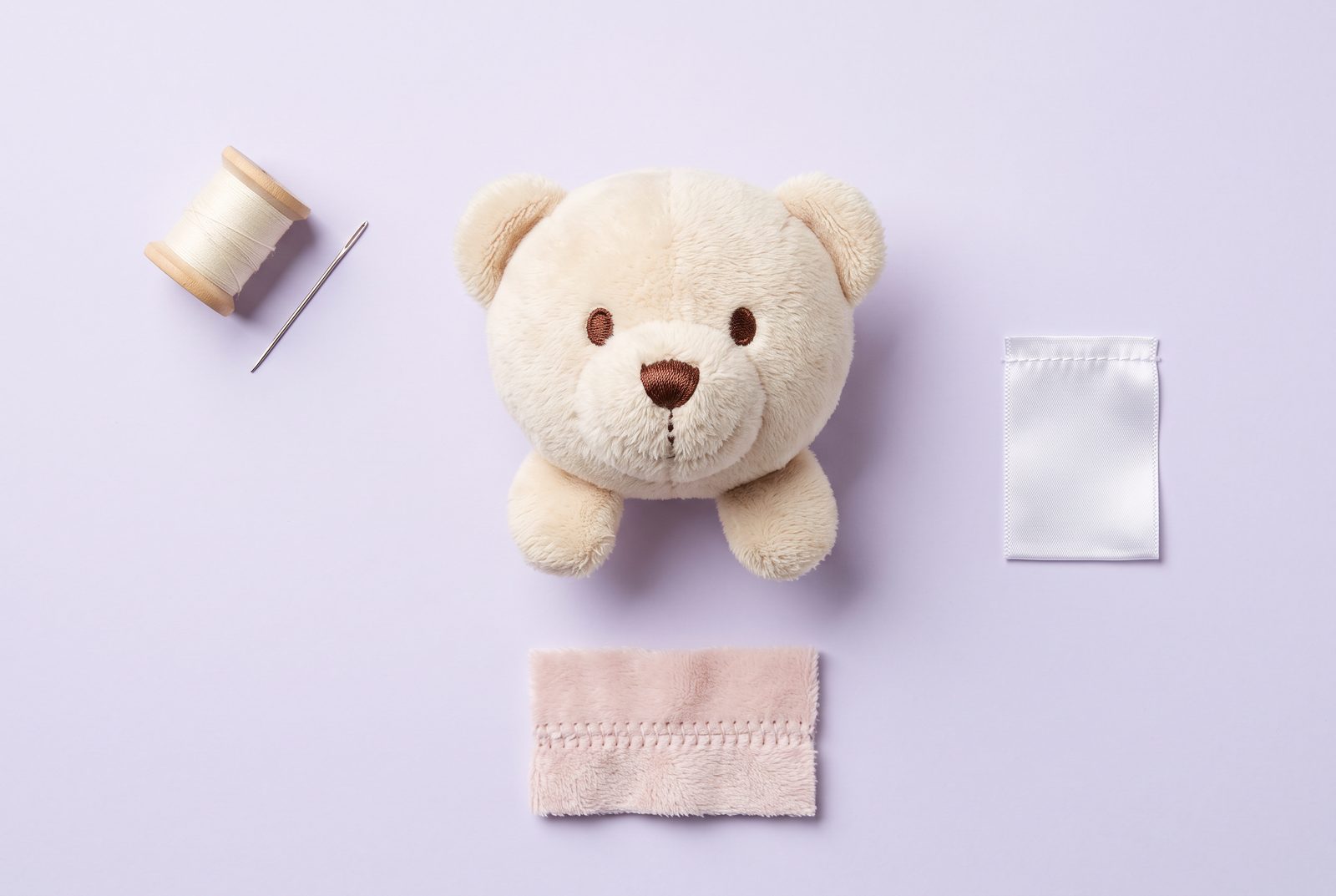
Part the fur along the seams, especially at the neck, legs and ears, where children pull. The stitches should be tight and even, with no loose thread and no gap showing the stuffing. A seam that opens after months of cuddles is easy to fix, and our guide on how to repair a stuffed toy shows the stitches that hold.
Fur
Run your hand against the pile, then pinch a small tuft. A few fibres on your fingers from a new toy are normal; a pinch that comes away every time is not. For a baby who puts everything in their mouth, short dense fur is easier to keep clean.
Stuffing and smell
Squeeze the tummy: it should spring back and hide nothing hard, unless a mechanism is advertised. A strong chemical smell on unpacking is a bad sign. Air the toy for 24 hours, and if the smell is still there after a wash that follows the label, keep it away from a toddler.
The label
It should be firmly sewn in and readable. If it bothers your child, photograph it before cutting it off: you keep the care advice and the model number on your phone.
Which soft toy suits which age?
Age decides almost everything: size, fur, accessories, and even where the toy goes at night.
The youngest are the most exposed. Of 1,360 injuries linked to plush toys, figurines and doll accessories seen in American emergency departments from 2010 to 2018, 23.6 % were serious, most often an object swallowed or inhaled with a risk of choking. Serious injuries affected children under 3 far more than those over 5 (Vega et al., 2022). Figurines caused most of them, but the lesson applies to every small part on a soft toy.
| Age | Rough size | What to look for | What to avoid |
|---|---|---|---|
| Birth to 1 year | 15 to 30 cm, very light | Flat comforter or small short-pile toy, embroidered eyes, machine washable | Any soft toy in the cot during sleep, loosely sewn bells and ribbons, weighted toys |
| 1 to 3 years | 20 to 40 cm, carried in one hand | A sturdy toy that goes everywhere, bought twice if it becomes the comforter | Crossed-out 0 to 3 symbol, small parts, battery compartment without a screw |
| 3 to 6 years | 30 to 60 cm | A partner for pretend play: a familiar animal, a character, a musical toy | A very large toy in a small bed, long cords and straps |
| 6 years and over | Any size, giant included | A toy from their own world, a collector’s piece, a cuddle cushion | Nothing in particular, apart from realistic care |
These sizes are comfort guides, not rules. A 2-year-old who adores a big plush dog is not wrong; they just need to carry it without tripping.
Night time has a rule of its own. The American Academy of Pediatrics advises putting babies to sleep on their back, on a firm flat surface, with no soft bedding (Moon et al., 2022). The HSE says the same for Irish families: no soft objects, toys or teddies in the cot, which should stay in your room for at least the first 6 months. Under 1 year, the soft toy is shared while your baby is awake, in your arms or on the play mat.
How demanding to be, depending on how the toy is used
Comforter or teddy: which is better for a baby?
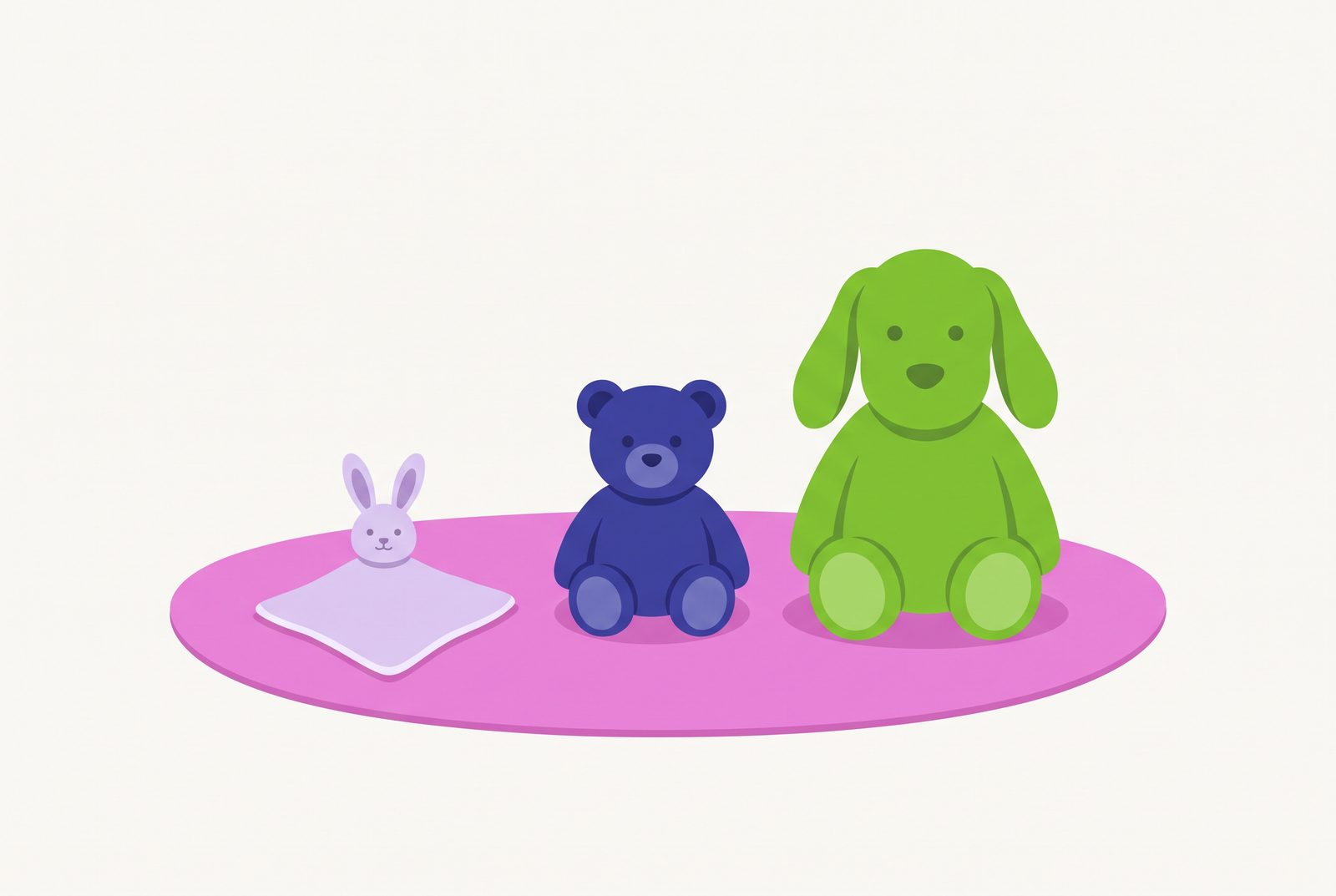
People use the words loosely, but the objects differ. A flat comforter, a square of soft fabric topped with a small animal head, crumples in a little hand and dries quickly. A teddy has volume, a whole body to squeeze, and takes up more room.
Flat comforter
From birth, while awake. Light and easy to grab, it dries in a few hours.
Small teddy
Around 1 year. About the length of a forearm, carried in one hand and small enough for the crèche bag.
Big soft toy
Around 3 years. For play and cuddles on the sofa, more rarely for sleep.
You do not really choose the comforter anyway. The child picks it, often towards the end of the first year, and it is not always the one you had in mind. What this attachment involves, and how to support it, is explained in our article on why a comfort blanket matters to a child.
One practical tip all the same: as soon as a soft toy becomes the favourite, buy an identical second one and rotate them. Brought in months later, the copy may be rejected.
Is there a soft toy for boys and one for girls?
No. A soft toy has no gender. A bear, a dinosaur or a unicorn appeals to every child who loves them, and that is what counts: the animal that makes them laugh, the one they look for in books or copy at the park.
Before 2, go by what catches their eye: a clearly drawn face, a colour contrast, a texture they stroke. By 3 or 4, let them choose, as they already have favourites. Plush animals remain the easiest to adopt, because the child knows the animal and can make it talk. The teddy bear has led the way for more than 100 years, and for good reasons: long arms, a round head, a calm face.
At 4, their worlds take shape: dinosaurs, the farm animals they see on a drive in the country, cartoon or video game heroes. A soft toy of their favourite character is likely to be adopted that very evening. Check the age on the label, as some collector’s models are aimed at older children.
Which fabric and stuffing should you choose?
Most soft toys today are polyester, inside and out. That is not a flaw: synthetic fibre handles washing well, dries faster than thick cotton and keeps its shape. Cotton, organic or not, and wool work too, as long as you follow their label, which is often stricter.
“Hypoallergenic” is not a toy standard. The word mostly signals synthetic stuffing, with no feathers or wool, and does not guarantee that no child will react. For an allergic child, the real issue is dust mites.
A new soft toy holds almost none: about 0.1 µg of dust mite allergen per gram of dust. Yet that level rose 10 to 20 times in the first 4 months of use, and only washing with detergent brought it down markedly, not vacuuming (Nagakura et al., 1996).
Hence our advice: for a comforter or a soft toy that sleeps in the bed, choose one whose label allows the washing machine. Our guide on how to wash a teddy bear explains every symbol.
For stuffing, hollow polyester fibre is the norm. Beads or pellets, which make a toy floppier or heavier, must be sealed in a pouch sewn inside. A seam giving way over loose beads means a handful of small parts within reach of a mouth.
Battery, weighted or giant soft toys: what precautions?
A musical toy, a night light or a breathing plush hides a unit and batteries. For a young child, choose a compartment closed with a screw, and keep spare batteries, especially button batteries, out of reach. The unit never goes in water.
A weighted soft toy is made for older children and adults, never for a baby or a toddler who could not push it away alone. Check the minimum age on its product page and label.
A giant teddy delights from age 3 or 4, placed on the floor or an armchair rather than in the bed. Choose a spot where it cannot become a step up to a window or a shelf. And if you are looking for the toy that will see your child off to sleep, our guide to soft toys for sleeping compares weighted, white noise and light-up models.
Quality soft toys: frequently asked questions
What is the difference between plush and soft toys?
In everyday use there is none: both mean a stuffed toy covered in fabric. Strictly, plush is a fabric with a raised pile, so a plush toy has fur, while soft toy also covers knitted, felt or cotton toys with no pile. The safety rules and the checks in this guide are the same for both.
How do you report an unsafe toy in Ireland?
Stop using it and tell the shop or website that sold it. Then contact the CCPC, the authority in charge of toy safety in Ireland, through its consumer helpline or website, giving the name, model and batch number from the label. A photo of the label and of the fault helps.
Is a soft toy with no label dangerous?
Not necessarily, but you have no way of knowing: no minimum age, no maker, no care advice. For a child under 3, give it a miss. For an older child, check the eyes, seams and small parts yourself, then treat it as a delicate toy, washed by hand or on the surface.
Can a young child have a collector’s soft toy?
Yes, if its label allows it. Many collector’s soft toys carry a high minimum age or the crossed-out 0 to 3 symbol, because of accessories, beads or long fur. Those stay on a shelf until the age shown, with a simple soft toy alongside for hugging and washing.
Sources
Moon R.Y., Carlin R.F., Hand I., Task Force on Sudden Infant Death Syndrome, Committee on Fetus and Newborn (2022). Sleep-Related Infant Deaths: Updated 2022 Recommendations for Reducing Infant Deaths in the Sleep Environment. Pediatrics, 150(1), e2022057990. DOI: 10.1542/peds.2022-057990
Nagakura T., Yasueda H., Obata T., Kanmuri M., Masaki T., Ihara N., Maekawa K. (1996). Major Dermatophagoides mite allergen, Der 1, in soft toys. Clinical & Experimental Allergy, 26(5), 585-589. DOI: 10.1111/j.1365-2222.1996.tb00580.x
Vega C., Kannikeswaran N., Farooqi A., Arora R. (2022). Toys and Toy Accessories Strike Back: Pediatric Injuries From Plush Toys, Toy Figurines, and Doll and Toy Accessories. Pediatric Emergency Care, 38(2), e714-e718. DOI: 10.1097/PEC.0000000000002389