
Contents
- Why sort the teddies before you buy any storage?
- Teddy storage ideas compared: which one for which room?
- Low storage your child can use alone
- Nets, hammocks and shelves: how do you hang teddies safely?
- How should teddy storage change as your child grows?
- Dust mites and pet hair: how do you protect stored teddies?
- Attic, hot press or wardrobe: where do teddies keep best for years?
- How do you display an adult teddy collection?
- Teddy storage: your questions answered
- Sources
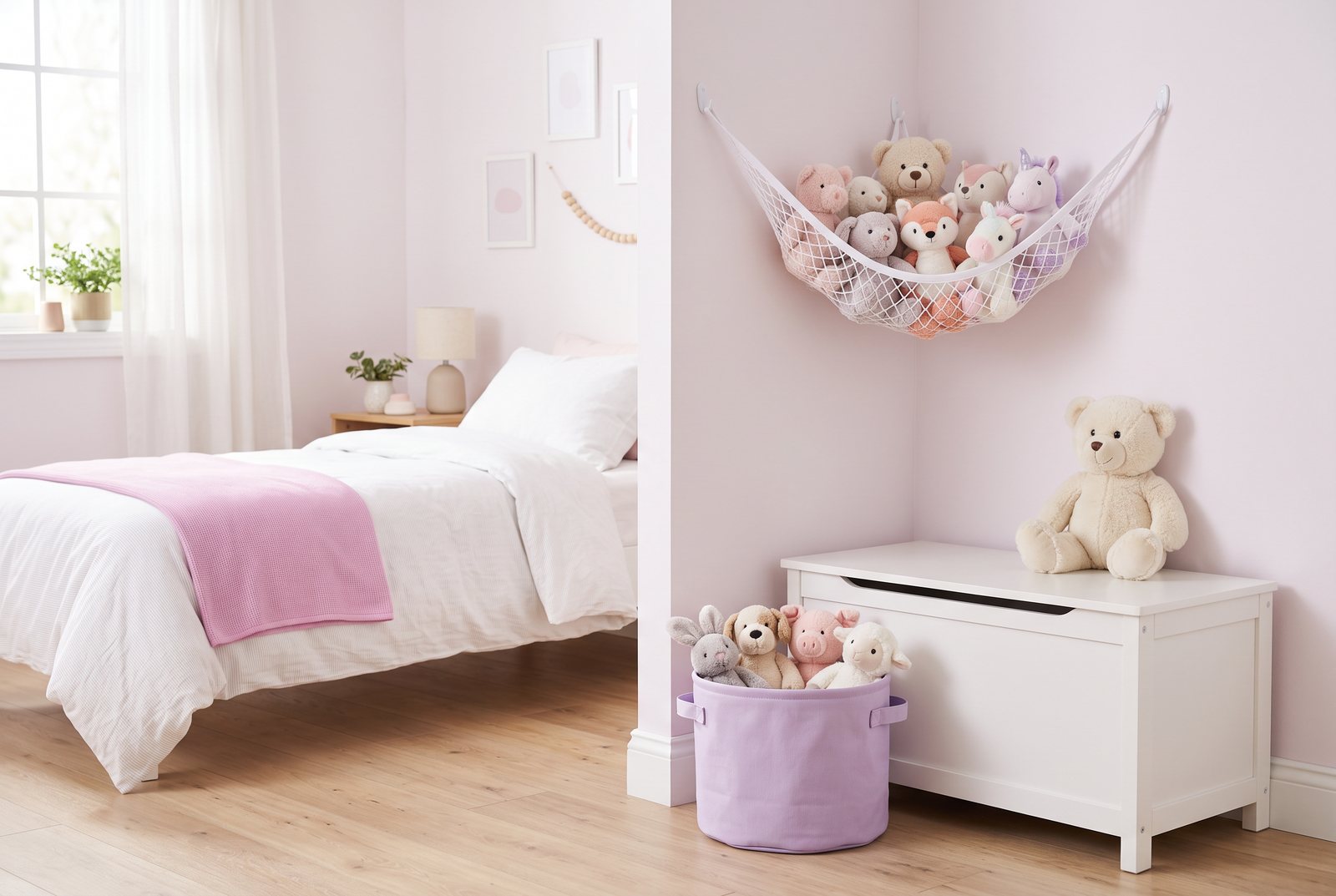
Good teddy storage ideas follow one order: sort the teddies first, then pick storage for the room and your child’s age. A low basket they can fill alone, a net or hammock to clear the floor of a small box room, shelves fixed to the wall for a collection. Favourites stay within reach; the rest go into something closed.
Between birthdays, Santa and every visit from a godparent, teddies pile up faster than they leave. A box room can fill up within a year. The fix is not one clever piece of furniture but three kinds of storage: for the teddies that get hugged, the ones that get admired and the ones you keep for later.
Why sort the teddies before you buy any storage?
Because storage only holds what you decide to keep. Without a sort, a new toy box is full by the next birthday. Put every teddy on the bed and give each one a destination.
Four piles, one afternoon
your child
Everyday
The comforter and the handful of teddies hugged each week.
Rotation
Liked but not needed now: boxed up, swapped back in a few weeks.
Memory box
The christening teddy, a gift from a grandparent: cleaned, wrapped, kept apart.
Passing on
The ones nobody misses: donated, sold or recycled.
Let your child lead the sort, with you deciding where things go. A small child does not see a teddy as a swappable object: when a stage trick seemed to make an exact copy, young children were much less willing to take the copy of their attachment object than of a favourite toy (Hood and Bloom, 2008). The comforter stays out of the sorting altogether.
Rotation pays off. In a study with 36 participants, all toddlers, those playing with 4 toys instead of 16 stayed longer with each one and used them in more varied ways (Dauch et al., 2018). Leave a small group of teddies out, keep the rest boxed in the wardrobe, and swap them every 2 or 3 weeks.
For the passing-on pile, our guide on how to recycle stuffed animals or give them away lists the options.
Teddy storage ideas compared: which one for which room?
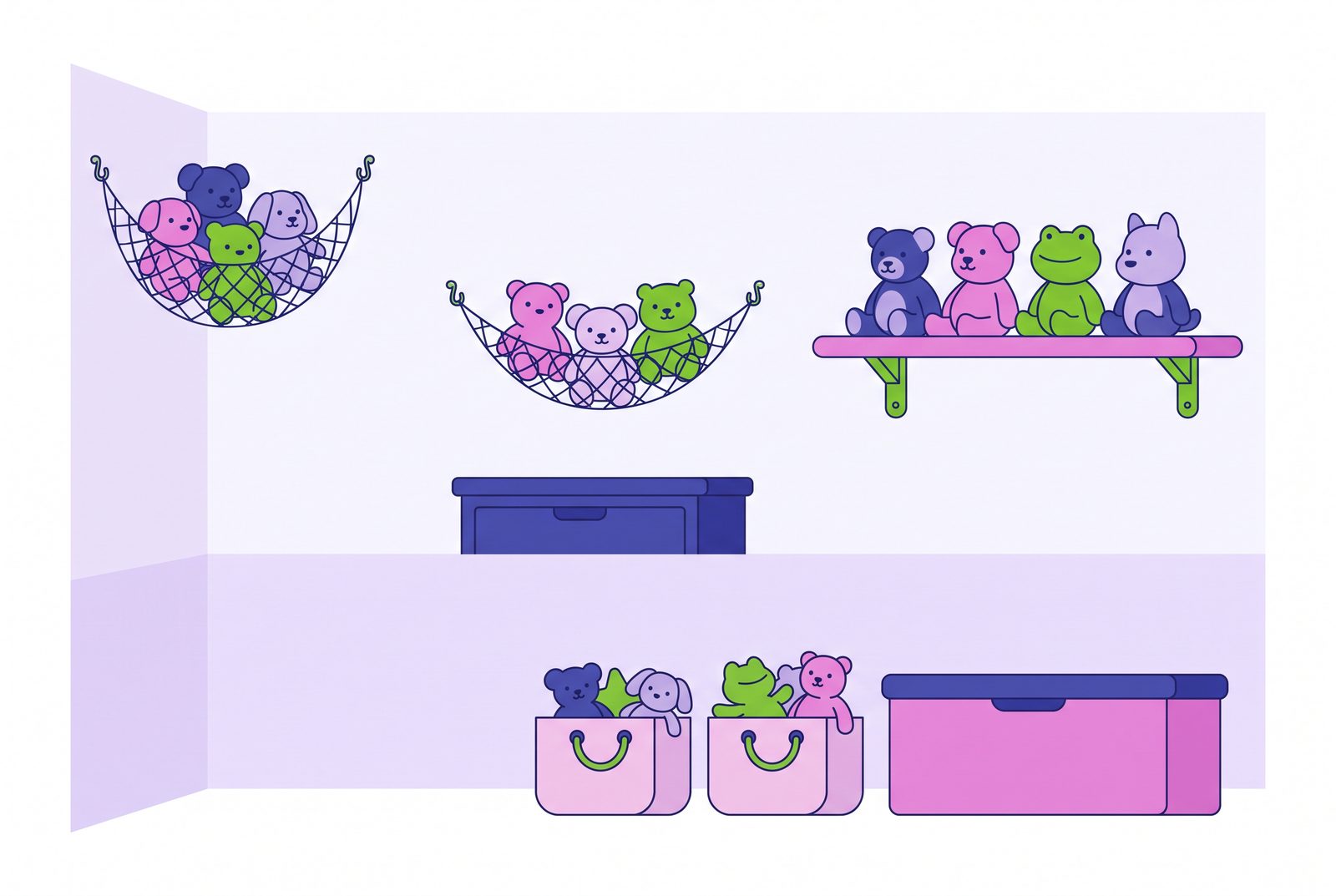
No option wins on everything. Each trades floor space against easy access for a small child and protection from dust.
| Storage | Best spot | Who puts teddies away | Dust | Check |
|---|---|---|---|---|
| Basket or fabric bin | Floor, under the bed | Your child, from walking age | Open | Teddies lost at the bottom |
| Toy box | Floor, against a wall | Your child | Covered when shut | A heavy lid that slams |
| Storage pouffe | Floor, used as a seat | Your child from about 3 | Covered | Overfilling flattens teddies |
| Storage bench | Foot of the bed, under a window | Your child | Covered | A slow-close hinge |
| Elastic cord zoo | Floor | Your child | Open | Cords losing their stretch |
| Corner net | High in a corner | An adult | Open on all sides | Wall fixings, never over a bed |
| Hammock | Above a chest of drawers | An adult | Open | Hooks bending |
| Shelves or cubes | Wall | Your child for the low ones | Open, easy to dust | Anchored to the wall |
| Door pocket organiser | Back of a door | Your child for the low pockets | Open | The door still closing |
| Lidded plastic box | Under the bed, top of the wardrobe | An adult | Well covered | Rotation only, never the comforter |
| Vacuum bag | Wardrobe, for a move | An adult | Well covered | Crushed stuffing, never an old teddy |
In practice, two levels work best: open and low for daily use, closed or high for the rest.
Low storage your child can use alone
Anything at floor level has one job: to be easier to use than the floor itself.
Baskets and fabric bins
They are what children actually use. Pick light ones with handles and no lid, shallow enough that your child sees the bottom. Several small bins work better than one deep one, where teddies vanish for months. A photo or drawing stuck on each bin, farm animals here and characters there, helps a child who cannot read yet.
Toy boxes, pouffes and storage benches
Closed storage keeps dust off and the room looks calmer. Test the lid before you buy: it should stay up on its own or close slowly on a soft-close stay, because a heavy lid falling on small fingers hurts. A large box should have air holes or a gap, in case a child climbs inside.
A storage pouffe, a padded cover you fill with teddies, gives a seat as well. Leave it half full; teddies pressed under a sitting adult for weeks lose their shape.
Some soft toys never need putting away. Plush cushions sit on the bed, the bench or the couch with the other cushions and leave the bins for real teddies.
The elastic cord zoo
A wooden frame with tight elastic cords across the front: teddies squeeze between the cords and stay on view, like animals behind a fence. Retighten or replace the cords every 3 months or so; slack cords let teddies tumble out and can snap back when they give.
Nets, hammocks and shelves: how do you hang teddies safely?
Going up frees the floor in a small room, and teddies up high become decoration rather than playthings.
Corner nets and hammocks
A net hangs across a corner from three hooks; a hammock stretches above a chest of drawers. The weak point is always the fixing. Internal walls are often plasterboard, and a screw without the right plug pulls out once twenty teddies are hanging from it, faster if a child swings on it. Match the plug to the wall, plasterboard or block.
Keep nets and hammocks away from beds and cots. A child standing in a cot reaches for anything hanging nearby, and cords and mesh are not toys.
Shelves, cubes and door organisers
Every shelf unit gets anchored to the wall, low ones included, because children climb.
children a year, on average, were treated in American emergency departments after furniture or a television tipped over, from 1990 to 2019. Nearly seven in ten were under 6.
Lu et al., 2021, Injury Epidemiology
A teddy on the top shelf invites climbing, with the bottom cube as a step. Screw an anti-tip strap or bracket into the wall, put the lightest teddies at the top and keep the bottom cubes for the ones your child may take alone. A pocket organiser on the back of the door stores small teddies without using any floor, and its lowest pockets are your child’s.
How should teddy storage change as your child grows?
A toddler needs storage that cannot hurt; a five-year-old needs storage they can manage; a twelve-year-old wants a room that no longer looks like a nursery.
Toddlers
Open, light, low bins. No heavy lids, nothing hanging near the bed, no teddies in the cot.
3 to 6 years
Your child tidies alone: picture labels, low cubes, a few teddies on rotation.
7 years and up
Shelf, bench or net chosen with them; keepsakes move to a closed box.
For babies, storage meets sleep safety. The HSE advises keeping a baby’s cot free of soft objects and anything loose or fluffy, toys and teddies included, and having the baby sleep in a cot in your room for at least the first 6 months. The American Academy of Pediatrics gives the same direction: a firm, flat surface with no soft bedding, to lower the risk of sleep-related deaths (Moon et al., 2022). The teddies wait in a basket beside the cot. When the comforter can come into bed at night is a question for your public health nurse or GP.
The comforter itself deserves a fixed home that never moves. Our article on why a comfort blanket is important for a child explains what it does at each age.
From about 3 years, aim for independence: show your child once, tidy together for a week, then step back and accept a slightly crooked result.
Dust mites and pet hair: how do you protect stored teddies?
Teddies are thick fabric that sits in one room for years, and they collect what is in the air. When researchers tested 40 children’s soft toys, all of them carried dust mite allergens, about 3 times more than the children’s mattresses (Wu et al., 2014). With a cat in the house, cat allergen on the toys reached 2.49 µg per gram of dust, against 0.48 µg in homes without one.
How well each option keeps dust off
Wash a teddy before it goes into a closed box, as its care label allows, and make sure it is dry to the core: our guide on how to wash a stuffed toy explains each method. Teddies nobody hugs belong in closed storage. The open ones get a pass of the vacuum now and then, brush head on low, to lift surface dust.
If your child has asthma or an allergy, ask your GP about storage and washing, and keep display teddies well away from the pillow.
Attic, hot press or wardrobe: where do teddies keep best for years?
In a damp climate, the enemy of a stored teddy is moisture, more than the box itself.
The hot press is handy to finish drying a washed teddy, but it is a poor place for years of storage next to the cylinder. An unheated attic, garage or shed gets damp in winter, and a teddy boxed there can come out smelling of mould. The top shelf of a wardrobe in a heated room is safer.
Use a lidded plastic box rather than cardboard, which absorbs moisture and draws insects, and slip each fragile teddy into a cotton pillowcase. Take the batteries out of musical, light-up and breathing teddies first: a battery left for months can leak and corrode the unit. Used batteries go back free to a shop that sells them or to a civic amenity site, never into the bin.
Vacuum bags save space for a house move. A synthetic teddy copes with a few weeks and plumps up again within 1 or 2 days of air. Left for months, the stuffing may not recover. Never vacuum-pack an old bear, a mohair one or one stuffed with wood wool.
Moths eat wool, mohair and felt. Open the box of an old bear every 6 months and look for small holes. Before boxing it, use our method to clean an old teddy bear without getting it wet through.
How do you display an adult teddy collection?
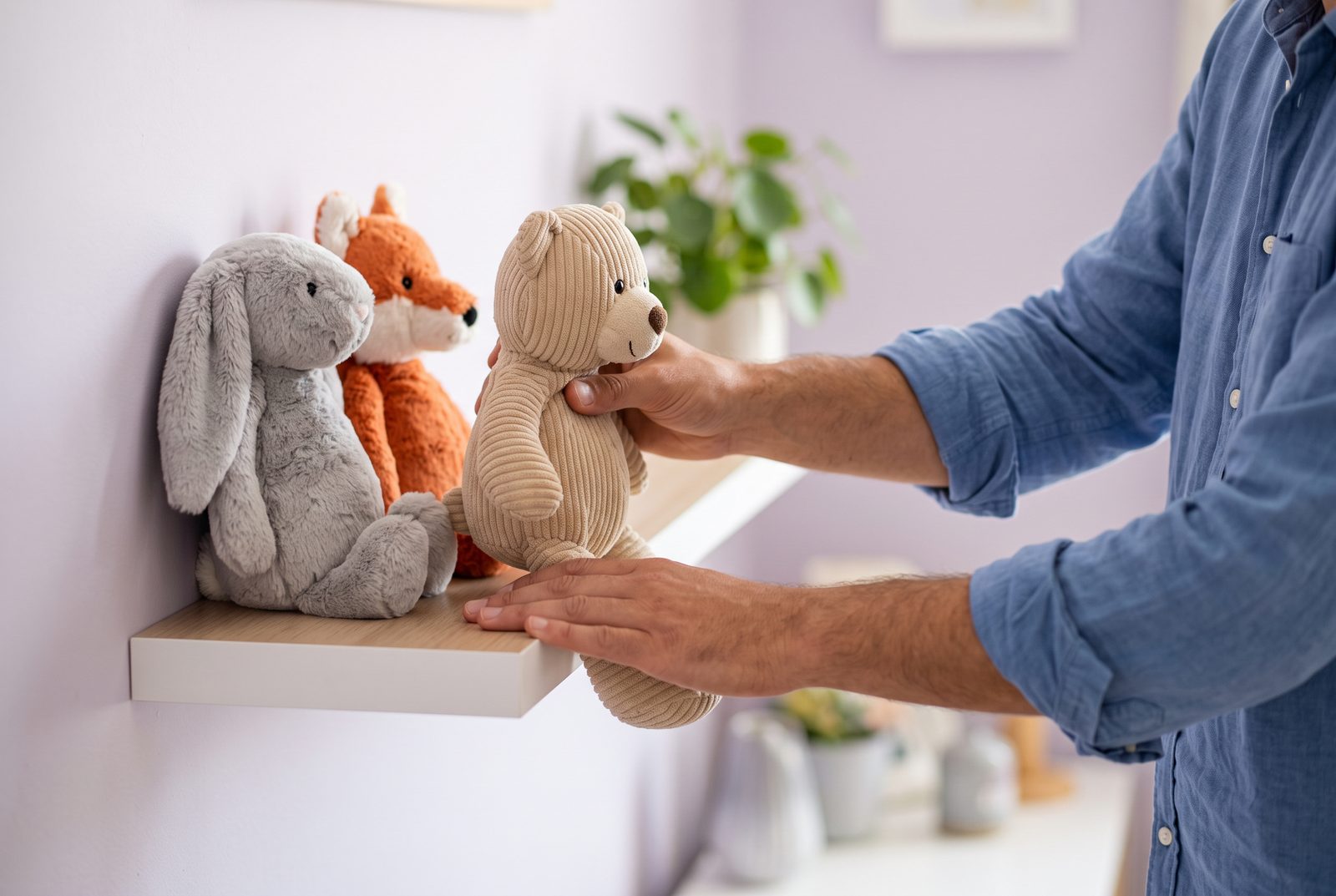
A collection looks better grouped than piled. Give each shelf a theme or a colour, and leave some wall empty. A glass-fronted cabinet keeps off dust and pet hair. Turn the teddies round every few months: the side facing the window fades.
A giant plush will not fit any basket: plan for it like a chair. Give it a corner of the couch, a spot at the end of the bed or a reading nook, and run the vacuum over it from time to time. Measure first, because a 1 m teddy sitting down takes roughly the seat of an armchair.
Teddy storage: your questions answered
Is it normal for a teenager to still sleep with a teddy?
Yes. Many teenagers, and plenty of adults, keep one soft toy on the bed, often the one they have had since they were small. There is nothing to fix. When the bedroom is redone for a teenager, give that teddy a place they choose, on the bed or a shelf, and pack the rest away gently.
Where can I donate or recycle old teddies in Ireland?
The textiles map on mywaste.ie lists over 1,500 donation and recycling points, and some charity shops take clean soft toys: ask first. Never leave bags beside a full bring bank, which counts as dumping. Toys with batteries go free to a civic amenity site or a shop that sells batteries, under the WEEE Ireland scheme.
What are good teddy storage ideas for a small box room?
Go up and behind. A pocket organiser on the back of the door holds twenty or so small teddies, a hammock above the chest of drawers frees the floor, and a lidded box slides under the bed for the ones on rotation. Keep the floor for one low basket your child can reach.
Where should the comforter go during the day?
Always in the same place, so nobody hunts for it at bedtime: on the bed, a low shelf or a hook at your child’s height, never at the bottom of a toy box. If it goes to the creche or the childminder, a small cloth pouch in the bag keeps it off the floor and stops it getting lost.
Sources
Dauch C., Imwalle M., Ocasio B., Metz A.E. (2018). The influence of the number of toys in the environment on toddlers’ play. Infant Behavior and Development, 50, 78-87. DOI: 10.1016/j.infbeh.2017.11.005
Hood B., Bloom P. (2008). Children prefer certain individuals over perfect duplicates. Cognition, 106(1), 455-462. DOI: 10.1016/j.cognition.2007.01.012
Lu C., Badeti J., Mehan T.J., Zhu M., Smith G.A. (2021). Furniture and television tip-over injuries to children treated in United States emergency departments. Injury Epidemiology, 8(1). DOI: 10.1186/s40621-021-00346-6
Moon R.Y., Carlin R.F., Hand I., Task Force on Sudden Infant Death Syndrome, Committee on Fetus and Newborn (2022). Sleep-Related Infant Deaths: Updated 2022 Recommendations for Reducing Infant Deaths in the Sleep Environment. Pediatrics, 150(1). DOI: 10.1542/peds.2022-057990
Wu F.F., Wu M.W., Ting M.H., Crane J., Siebers R. (2014). Cat, dog and house dust mite allergen levels on children’s soft toys. Journal of Asthma, 51(1), 75-78. DOI: 10.3109/02770903.2013.843097