

Contents
- How does a teddy bear with a voice recorder work?
- What other talking teddies are there?
- What age is a talking teddy for?
- How loud should a lullaby teddy be?
- Will a talking teddy help your toddler talk?
- What happens to your child’s voice with a connected teddy?
- Which safety checks matter most?
- How do you clean a talking or voice recorder teddy?
- Questions about talking and voice recorder teddies
- Sources
A teddy bear with a voice recorder keeps a few seconds of a loved one’s voice that a child can replay at the press of a paw. Other talking teddies repeat what the child says, play recorded phrases, sing or hum white noise, and connected ones answer online. Check the age on the box, a screwed battery cover, the volume and, if it connects, where the voice goes.
A grandparent in Boston or Brisbane saying goodnight, every night, from a teddy on the pillow: few gifts travel so far for so little. Picking the right one still takes a few minutes of checks.
How does a teddy bear with a voice recorder work?
Inside, a small sound module sits in a pocket, usually behind a hook-and-loop strip or a seam. You press the record button, speak, and the message stays until you record over it. A press on the paw or tummy then plays it back. Most modules hold a short message, a few seconds to perhaps half a minute: check the length on the box if you have a song or a story in mind.
It is the most personal of the talking teddies: a parent working away, a granny across the water, a lullaby sung the way only one person sings it. Some families record a voice as a keepsake after a loss; if that is your case, keep a copy of the recording elsewhere too, because modules and batteries do not last forever. Handy with a needle? A recording module fits into a pocket planned at the pattern stage, and our guide to making a soft toy shows you how.
What other talking teddies are there?
The voice recorder is one of five families. The difference matters for safety and for privacy.
Five ways a teddy can talk
teddy
Recorded at the factory
A squeeze sets off the same few words or a song every time.
Repeating
A microphone catches the child’s words and plays them straight back, higher. Nothing leaves the toy.
Voice recorder
A module keeps a message from a loved one, replayed as often as the child likes.
Lullabies and white noise
A sound box plays tunes, rain or a steady hush, often with a timer.
Connected or AI
Through an app, it sends the voice to a server and replies with a sentence made up on the spot.
Our shop mostly offers soft toys that sing and soothe: the musical soft toys play lullabies, and the white noise soft toys bring calming sounds to bedtime.
What age is a talking teddy for?
The age on the packaging comes first. “Not suitable for children under 36 months” means small parts, often the sound box and its batteries. Use the table only as a second step.
| Age | Good choice | Avoid |
|---|---|---|
| Under 1 | Lullaby or white noise, toy kept out of the cot, lowest volume | Any soft toy in the cot during sleep; sound played close to the ear |
| 1 to 3 | A teddy whose box allows this age, singing or saying a few words when pressed | Reachable sound box, button batteries, small parts |
| 3 to 6 | Voice recorder teddy, repeating teddy, storytelling teddy | No volume control, sounds that start on their own at night |
| Over 6 | Connected teddy, set up and used with you | Microphone always on, app without parental controls |
For babies, the HSE advises keeping the cot free of soft or fluffy objects, teddies and toys included. A lullaby teddy belongs on a shelf or a chest of drawers, out of reach of the cot, switched on at bedtime.
How loud should a lullaby teddy be?
White noise can run for hours near a very young ear, so volume matters more than the tune. When researchers measured 14 infant sleep machines at full volume, allowing for a 6-month-old’s ear canal, every one went above 50 dBA at 30 cm, the limit recommended in hospital nurseries. Three passed 85 dBA, beyond what is accepted for adults at work over 8 hours (Hugh et al., 2014).
Average loudness of toys with a speaker, by distance
Those toys averaged 107.6 dBA at the speaker and 82.5 dBA at 25 cm (Weinreich et al., 2013). Distance is your friend, and it is the first thing lost when a child cuddles the teddy against their ear.
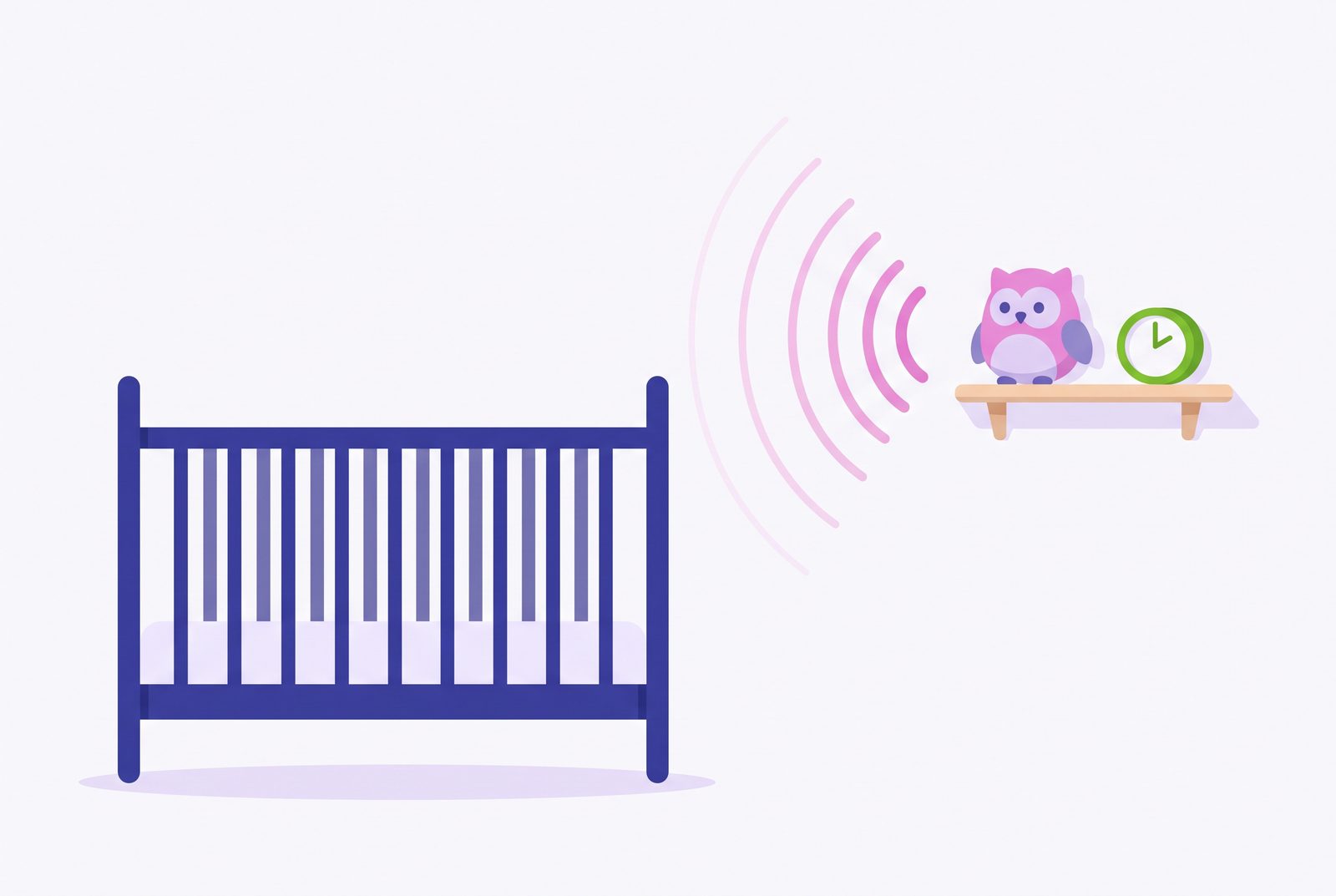
Place the teddy as far from the cot as you can, use the lowest setting that works and the timer rather than a loop, and test it at pillow height. For more on bedtime companions, see our guide to choosing a soft toy for sleep.
Will a talking teddy help your toddler talk?
Probably not on its own. In a home study of 26 parents and their children aged 10 to 16 months, 15-minute play sessions with electronic toys produced fewer adult words, fewer parental responses and fewer back-and-forth exchanges than with traditional toys or books, and the children vocalised less than with books (Sosa, 2016).
The promise and the measurements
On the box
- Teaches your baby new words.
- Talks with your child.
- More talking means more learning.
In the study
- Parents said fewer words.
- Fewer turns in the conversation.
- Books got parents talking most.
So let the teddy start the game, then take over: name the animal, copy its sound, wait for an answer. A voice recorder teddy has an edge here, since the voice it plays is yours or a relative’s.
What happens to your child’s voice with a connected teddy?
A repeating teddy keeps the sentence for a moment on its chip, then overwrites it. A connected teddy usually sends the voice out of your home to build an answer.
Where a sentence goes with a connected teddy
When researchers watched families play with two connected toys, the children often did not realise that other people could hear what they told the toy, while parents worried about privacy and wanted real parental controls (McReynolds et al., 2017). AI teddies add another unknown: replies made up on the fly. Test one yourself at length before your child does.
| Check | Where | Why |
|---|---|---|
| Where recordings are stored | Privacy policy | To know which country holds the voice |
| How long they are kept | Privacy policy, app | A clear period should be stated |
| How to delete them | App, customer service | GDPR gives you a right to erasure |
| How to turn the microphone off | Instructions, toy | To know when it is listening |
| How pairing works | Instructions | A code or button stops a stranger connecting |
| Who consents | Account set-up | In Ireland, a parent must consent for a child under 16 |
That age of 16 is set by Irish data protection law, and the Data Protection Commission is the body to contact if a company will not delete your child’s recordings.
Which safety checks matter most?
Small repeating and singing teddies often use button batteries, the flat coin-sized cells that are the most dangerous if swallowed. Stuck in the oesophagus, one can cause a severe burn within two to two and a half hours, with far worse outcomes in children under 4 (Litovitz et al., 2010).
The Competition and Consumer Protection Commission, which oversees toy safety in Ireland, advises batteries behind a securely fastened cover, spare batteries out of reach, and no more use of a toy whose batteries a child can get at. Look for the CE mark too, a speaker hidden under the fabric, and a sound box held in a closed pocket. EN 71 sets noise limits for toys, among other rules.
If you suspect a battery has been swallowed, go straight to A&E or ring 112 or 999, even if your child seems fine, and do not make them vomit. For a toy that walks as well as barks, our guide to walking dog toys covers remotes and batteries.
How do you clean a talking or voice recorder teddy?
Keep the sound module away from water. Open the hook-and-loop strip or the pocket, take the module out, and wash the cover following its label. If the module is stitched in, clean the surface only, with a barely damp cloth along the fur.
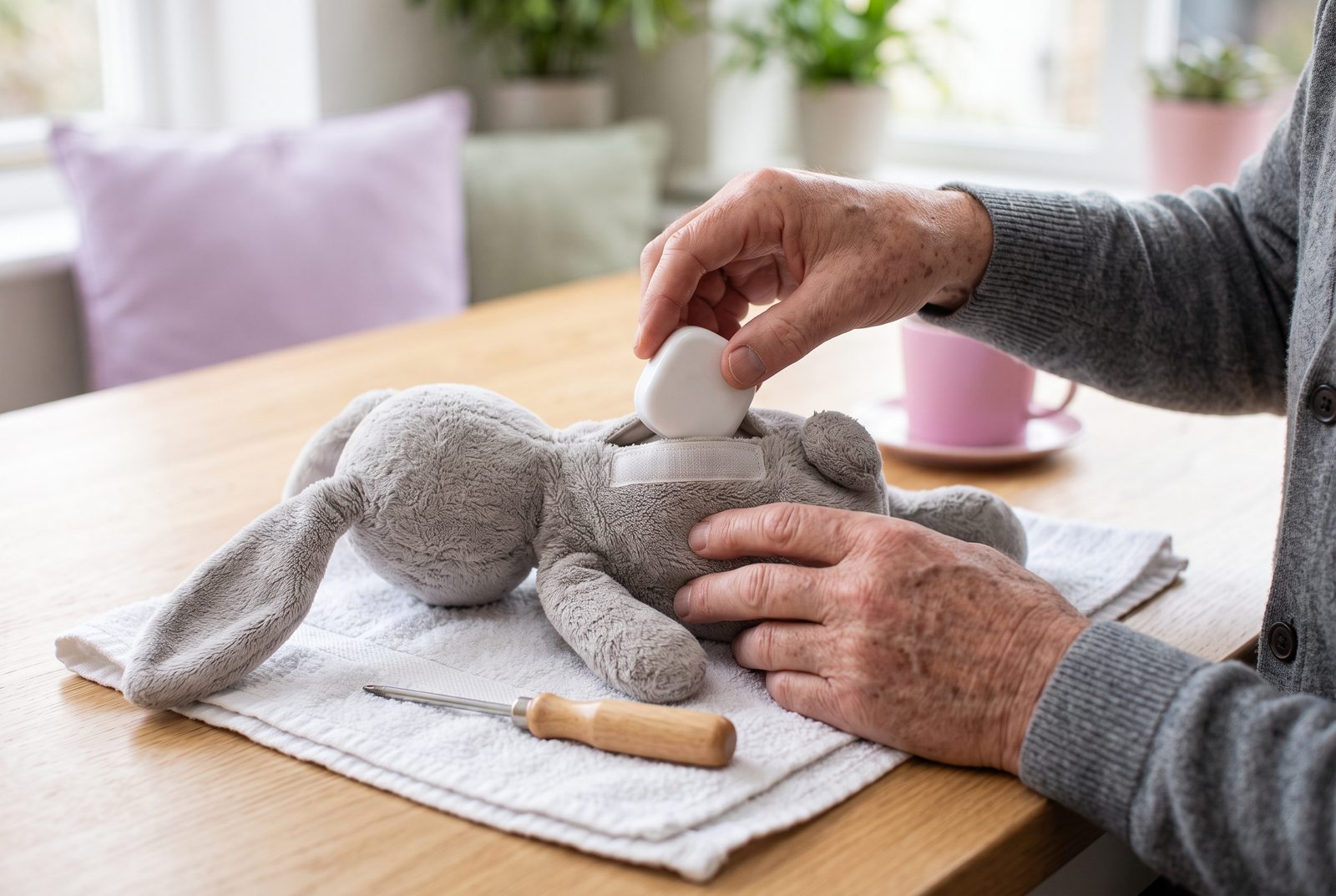
Dry the teddy right through before putting the module back, which can take longer than you expect in a damp Irish winter, or the contacts will corrode. Remove the batteries if it is stored away, and take used ones to a WEEE Ireland drop-off point, never the bin. Every washing method is in our guide to washing musical and battery soft toys.
Questions about talking and voice recorder teddies
Will a repeating teddy speak Irish?
Yes: a repeating teddy simply plays back what it has just heard, so it copies Irish, English or any other language your child speaks to it. Teddies with phrases recorded at the factory are another matter: most speak English only, so check the language on the box or product page before buying.
Does a talking teddy need wifi to work?
In most cases, no. Teddies with recorded phrases, repeating teddies, voice recorder teddies and those that sing or play white noise all run on ordinary batteries without any connection. Only connected or AI teddies need an app, Bluetooth or wifi, and those deserve a close look at their privacy settings.
Why do repeating teddies sound so squeaky?
The module plays the recording back at a higher pitch, often a little faster, which creates the cartoon voice children find so funny. A few models let you adjust the pitch; most do not. If you are giving it to a family that will hear it fifty times a day, listen to it first.
Sources
Hugh S.C., Wolter N.E., Propst E.J., Gordon K.A., Cushing S.L., Papsin B.C. (2014). Infant sleep machines and hazardous sound pressure levels. Pediatrics, 133(4), 677-681. DOI: 10.1542/peds.2013-3617
Litovitz T., Whitaker N., Clark L., White N.C., Marsolek M. (2010). Emerging battery-ingestion hazard: clinical implications. Pediatrics, 125(6), 1168-1177. DOI: 10.1542/peds.2009-3037
McReynolds E., Hubbard S., Lau T., Saraf A., Cakmak M., Roesner F. (2017). Toys that listen: a study of parents, children, and internet-connected toys. Proceedings of the 2017 CHI Conference on Human Factors in Computing Systems, 5197-5207. DOI: 10.1145/3025453.3025735
Sosa A.V. (2016). Association of the type of toy used during play with the quantity and quality of parent-infant communication. JAMA Pediatrics, 170(2), 132-137. DOI: 10.1001/jamapediatrics.2015.3753
Weinreich H.M., Jabbour N., Levine S., Yueh B. (2013). Limiting hazardous noise exposure from noisy toys: simple, sticky solutions. The Laryngoscope, 123(9), 2240-2244. DOI: 10.1002/lary.23667