
Contents
- Walking soft toy or robot dog: what is the difference?
- What age is a walking dog toy for?
- Which control is easiest: lead, remote or sensors?
- Why do button batteries matter so much?
- How loud is too loud for a barking toy?
- Will a walking dog replace the teddy on the bed?
- What should you check before you buy?
- How do you clean a walking dog toy?
- Your questions about walking dog toys
- Sources
A good walking dog toy matches the age on its box and the way your child likes to play: a rocking dog with no batteries, a motorised dog with a switch, or one steered by a lead or a remote. Before it goes under the tree, check for a CE mark, a battery cover that needs a screwdriver and a bark you can bear right beside your ear.
A puppy that follows your child round the kitchen, no muddy paws, no walks in the rain: it is easy to see the appeal. A few checks in the shop make the difference between a toy that delights for months and one that ends up in a drawer, or worse.
Walking soft toy or robot dog: what is the difference?
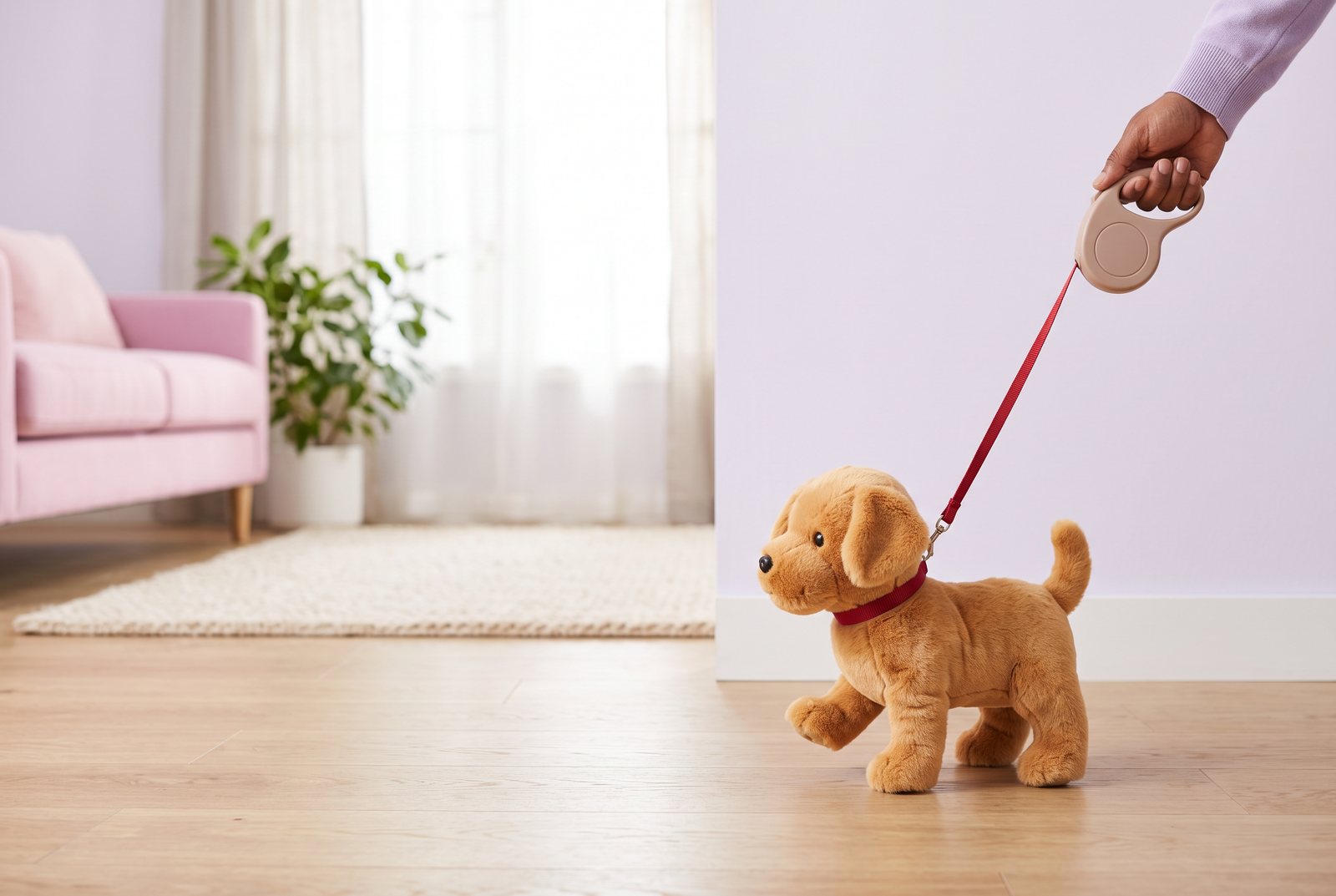
A robot dog is a plastic toy, often controlled from a phone app, that performs tricks. A walking soft toy dog keeps its fur and stuffing: once switched off, it is a cuddly toy like any other. Within the soft toys, three families share the name.
Rocking, no batteries
Held under the tummy and swung gently, its legs gallop. Nothing to charge, nothing to unscrew.
Motor and switch
Batteries under the tummy drive small steps, a bark, a wagging tail, sometimes a reaction to a pat on the head.
Lead or remote
A button in the lead handle, or a wireless remote, sends it forwards, round and into a sit. Some answer to the voice.
Rocking dogs are the simplest and often the most loved, because the child stays in charge of every step. Motorised dogs are the classic picture: lead held tight, little steps on the tiles. Remote-controlled ones add turns, sits and short sequences of moves, and appeal to children who like giving orders.
What age is a walking dog toy for?
Read the age on the box as a safety warning, not a skill level. The crossed-out baby face symbol, or “not suitable for children under 36 months”, means small parts that could come loose and be swallowed. Staying beside the child does not change that: an eye or a battery goes down in a second, with an adult in the room.
A walking dog for each age
For a 3 or 4 year old, the lead wins: one button, and off it goes. A remote with six keys asks a small child to work out which way the dog is facing, which is harder than it looks.
Which control is easiest: lead, remote or sensors?
The control decides how the toy is played with, and what needs watching.
| Control | How it works | Best for | Keep an eye on |
|---|---|---|---|
| Rocking | You swing it, the legs gallop | Cuddles and laughs, at the age on the box | Mechanism inside: never in water |
| Switch only | Walks straight ahead and barks | Younger children trying it out | Bumps into the furniture; the bark cannot always be muted |
| Lead with handle | A button in the handle makes it walk | From about 3, if the box says so | The lead is a cord: never in the bed, never round the neck |
| Wireless remote | Forwards, back, turn, sit | Around 5 or 6 | Battery type in the remote, screwed cover |
| Touch or sound sensors | Answers a pat, a clap or a word | Children who chat to their dog | Can wake up alone at night if left on |
Look at the switch too. One hidden under the tummy, behind fabric, survives curious fingers. One on the back goes off with every hug, usually at bedtime.
Why do button batteries matter so much?
Most walking dogs take ordinary round AA or AAA batteries. Button batteries, the flat discs the size of a coin, are more likely to be found in wireless remotes, light-up collars and small sound boxes. They are the real hazard.
A swallowed button battery can lodge in the oesophagus and cause severe burns within two to two and a half hours. In an analysis of more than 56,000 cases, outcomes were far worse with lithium cells of 20 mm and over, and in children under 4; in 92 % of the deaths, nobody had seen the battery go down (Litovitz et al., 2010).
of the 20 mm lithium cells swallowed by young children were meant for remote controls, more than for any other product.
Litovitz, Whitaker and Clark, 2010, Pediatrics, analysis of 8,648 cases
In the same series, 61.8 % of the batteries swallowed by children under 6 came straight out of a product, which is why the authors call for compartments that need a tool to open (Litovitz, Whitaker and Clark, 2010). The Competition and Consumer Protection Commission, which oversees toy safety in Ireland, gives the same advice: batteries behind a securely fastened cover, spares out of reach, and stop using a toy whose batteries a child can get at.
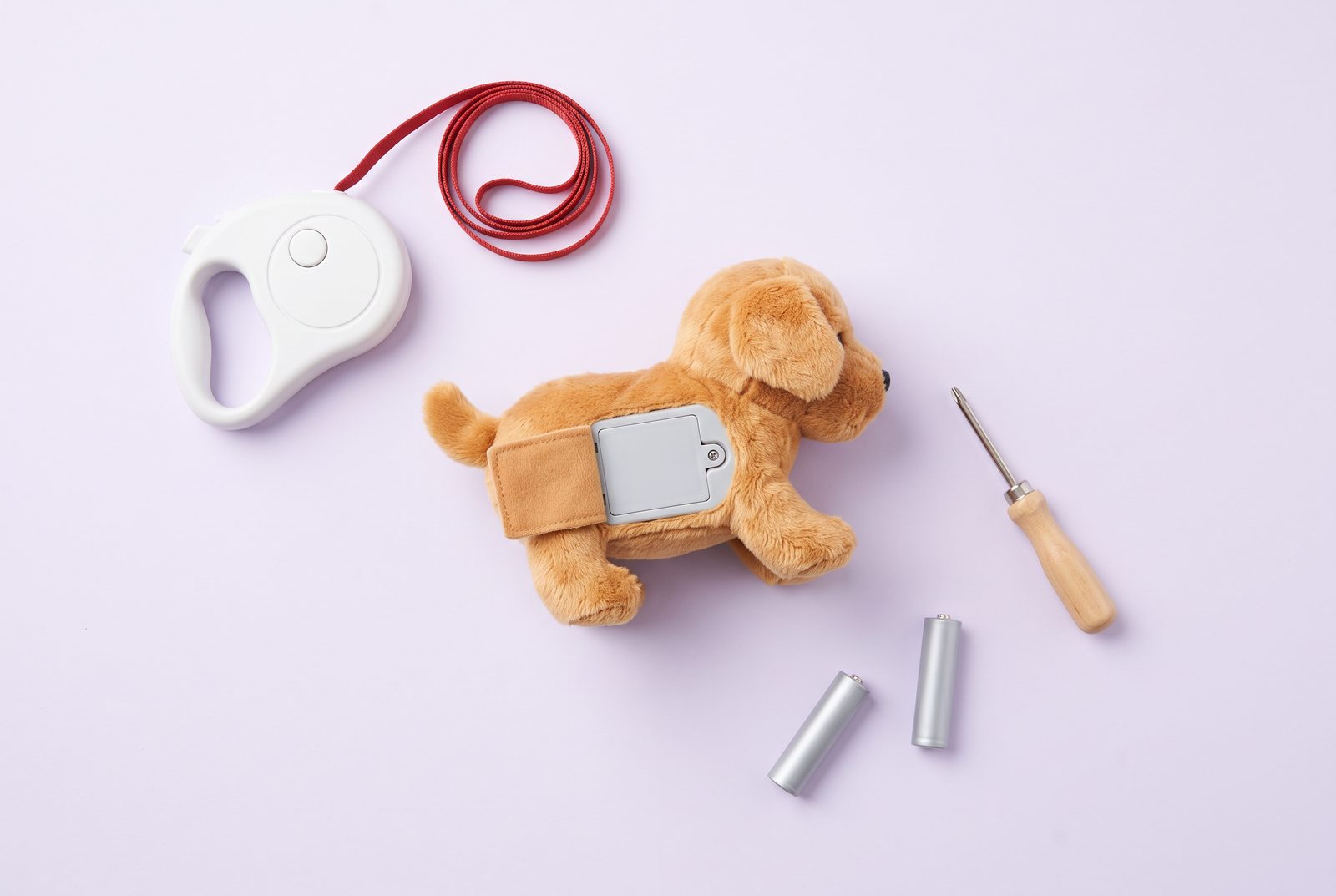
If you think a battery has been swallowed, go straight to A&E, as the CCPC advises, or ring 112 or 999, even if your child seems well. Do not make them vomit, and bring the battery packet. Signs are easy to miss: at least 27 % of the serious cases in the analysis were misdiagnosed at first (Litovitz et al., 2010).
How loud is too loud for a barking toy?
A bark that sounds cute in the shop is very different pressed against a small ear. Researchers tested 90 noisy toys sold for children over 6 months: on average 100 dBA at the speaker and 80 dBA at 30 cm. At the speaker, 98 % went above 85 dBA, and 26 % still did at 30 cm, whatever age the box showed (Mahboubi et al., 2013).
At work, under European rules applied in Ireland, 85 dB(A) averaged over a day is the point at which hearing protection must be worn. A child hugging a barking dog does not get that protection.
Try it yourself: make the dog bark a hand’s width from your ear. If you flinch, look for a model whose sound can be switched off while it keeps walking, or one with a volume setting. If it is the voice your child loves more than the walk, our guide to talking soft toys looks at sound modules in detail.
Will a walking dog replace the teddy on the bed?
Probably not. In a study of 80 children aged 34 to 74 months, about 3 to 6, each played with a robot dog from the shops and with an ordinary stuffed dog (Kahn et al., 2006). They reasoned about both in a similar way, but behaved differently: more wary of the robot and keener to get a response from it, as with an animal; rougher with the stuffed dog, and far more likely to give it an imaginary life of their own.
A toy that moves surprises and entertains. A toy that stays still leaves room for the story the child invents. The two sit well side by side, so a model that switches fully off, and becomes a cuddly toy again, gets the best of both.
And if the walking dog is really standing in for the real dog your child keeps asking for, it helps them wait. It does not teach the walks, feeds and company a real dog needs.
What should you check before you buy?
Five minutes are enough. Look for the CE mark on the toy or its box, the name and an address in the EU of the manufacturer or importer, and safety warnings you can read.
Tug gently at the eyes, nose and ears: nothing should give. Feel along the tummy seams where the battery box sits; no hard part should be exposed. Our guide to choosing a well-made soft toy explains how to judge seams, stuffing and eyes.
Then switch it on. The motor should not heat up or smell of hot plastic, and the bark should be bearable. If your child would rather have a dog that sits quietly on the pillow, our soft toy dogs go from poodles to huskies, and include an interactive puppy that walks and barks.
How do you clean a walking dog toy?
Never in the washing machine and never in water while the mechanism is inside: the battery box, motor and gears under the fur would corrode or short-circuit.
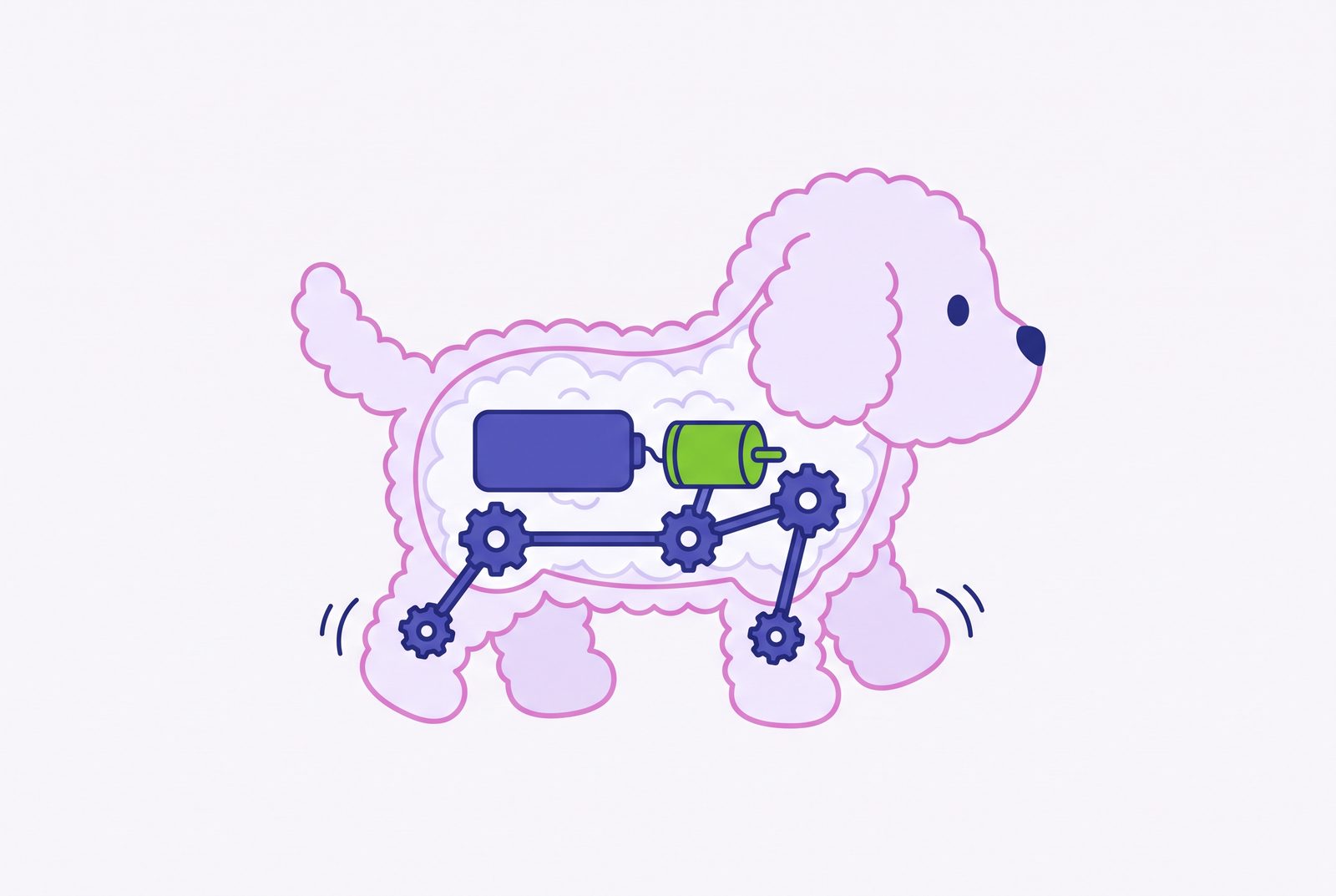
If the box comes out through an opening, take it out and wash the cover as its label says. If it is stitched in, clean the surface only, with a barely damp cloth and a drop of mild soap along the fur, then a dry cloth. Our guide to washing a soft toy covers battery toys too.
Storing the dog away? Remove the batteries, since a forgotten one often leaks onto the contacts. Used batteries never go in the bin: WEEE Ireland collection points, at civic amenity sites and in shops that sell batteries, take them back free of charge.
Your questions about walking dog toys
Is there a toy dog that looks and acts real?
Some come close: soft fur, a wagging tail, a bark, a head that turns when patted. None behaves like a living dog, and that is fine for a child, who fills the gaps with imagination. Be wary of claims of a dog that learns or understands you: check what the box actually lists.
Which batteries does a walking dog toy take?
Most take two to four standard AA or AAA batteries, often not included, so have them ready on the day. The size is printed on the box or the product page. The remote control may use a button battery, which needs the same screwed cover as the dog. Rechargeables are fine unless the maker rules them out.
Will a walking dog toy go on a rug?
On wooden floors, laminate or tiles, most walk easily. On a thick rug or deep carpet their small feet slip and the motor strains, which empties the batteries faster. A clear hall or kitchen floor makes the best track. Rocking models walk anywhere, since you carry them.
Would a walking dog suit a grandparent?
It can, if it makes them smile: nothing keeps these toys for children. For an older person, choose a light model with a switch easy to find by touch and a bark that can be turned down. A rocking dog with no batteries avoids tiny screws and remotes with lots of buttons.
Sources
Kahn P.H., Friedman B., Pérez-Granados D.R., Freier N.G. (2006). Robotic pets in the lives of preschool children. Interaction Studies, 7(3), 405-436. DOI: 10.1075/is.7.3.13kah
Litovitz T., Whitaker N., Clark L., White N.C., Marsolek M. (2010). Emerging battery-ingestion hazard: clinical implications. Pediatrics, 125(6), 1168-1177. DOI: 10.1542/peds.2009-3037
Litovitz T., Whitaker N., Clark L. (2010). Preventing battery ingestions: an analysis of 8648 cases. Pediatrics, 125(6), 1178-1183. DOI: 10.1542/peds.2009-3038
Mahboubi H., Oliaei S., Badran K.W., Ziai K., Chang J., Zardouz S., Shahriari S., Djalilian H.R. (2013). Systematic assessment of noise amplitude generated by toys intended for young children. Otolaryngology, Head and Neck Surgery, 148(6), 1043-1047. DOI: 10.1177/0194599813482293