
Contents
- What makes a teddy bear look creepy?
- Why do so many people love a scary teddy?
- Which kinds of spooky soft toys can you choose from?
- Why does Huggy Wuggy scare children so much?
- From what age can a child have a scary teddy bear?
- How can you help a child who is afraid of a soft toy?
- Your questions about scary teddy bears
- Sources
A scary teddy bear keeps the soft fur of a cuddly toy and adds something that does not belong: fangs, a fixed stare, a grin stitched too wide, arms that are nearly human. Older children and adults enjoy that little jolt. A toddler may not. So the right choice depends on who it is for, and the bedroom of a small child is better left to friendly monsters.
Halloween was born here, after all. It grew out of the old festival of Samhain, and Irish families carved lanterns from turnips long before anyone thought of pumpkins. A spooky bear on the shelf every October fits that tradition well. Here is why some soft toys unsettle us, why we enjoy it, and how to help a child who is genuinely scared.
What makes a teddy bear look creepy?
A classic teddy ticks every box for “cute”: a big round head, large eyes, a small nose, a chubby body. Behavioural scientists call this the baby schema. In an experiment with 122 people, all university students, photos of babies edited to exaggerate those features were rated cuter and made people keener to look after them (Glocker et al., 2009).
A scary bear keeps part of that pattern and breaks the rest. That mismatch is what unsettles. A soft bear with a row of fangs, a rabbit with red eyes and no pupils, a rag doll whose stitched smile runs too wide: your brain recognises something to cuddle, then a single detail contradicts it.
From comforter to monster: what tips a soft toy over
Realism is the other trigger. Researchers talk about the “uncanny valley”: a face that is nearly human, but not quite, makes people uneasy. Dolls and soft toys with very human features slide into it easily. That unease is not something we are born with. In a study of 240 children aged 3 to 18 years, only those over 9 years found a very human-looking robot creepier than a mechanical one; younger children saw no difference (Brink et al., 2019).
From this age, children in the study found a human-like robot creepier than a machine-like one, just as adults do. Younger children noticed no difference.
Brink et al., 2019, Child Development
Why do so many people love a scary teddy?
Because being scared, when you know you are safe, can be fun. Researchers fitted heart-rate monitors to 110 people aged 12 to 57 years at a haunted attraction. Enjoyment followed a bell curve: too little fear was boring, too much spoiled it, and the sweet spot sat in the middle, at a “just right” level of fright (Andersen et al., 2020).
A creepy bear plays on that small shiver. It is fabric, it is in your hands, you can turn it round or put it in a drawer. It lets you play with fear without being overwhelmed by it. That is why it goes down so well with teenagers and adults, and far less well with toddlers, who cannot yet hold the line between pretend and real.
Humour matters too. A two-faced bear, sweet at rest and snarling when you press its head, exists mainly to make a friend or a colleague jump. A reversible octopus with its grumpy side plays the same trick in a gentler key; our guide to the reversible octopus plush explains how children use it to show their mood.
Collectors want the object itself: the creature from a cult film, the monster from a video game, the Halloween piece that comes out of the press every October. For them the shiver is part of the charm.
Which kinds of spooky soft toys can you choose from?
Not all Halloween plush toys deliver the same chill. Some will make a 3-year-old giggle, others are designed for horror fans. This table helps you sort them.
| Style | What makes it scary | Who it suits | Our advice |
|---|---|---|---|
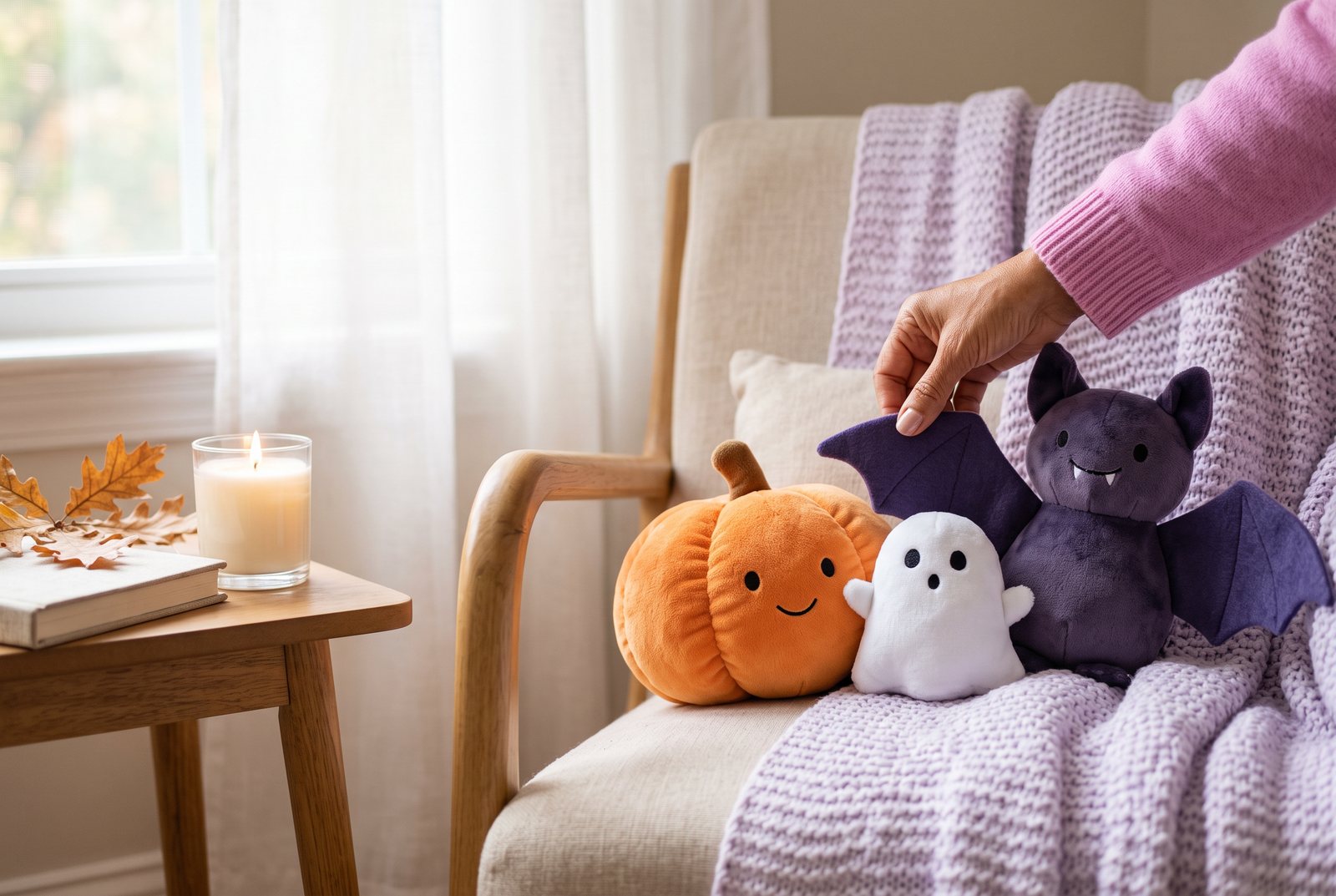
| Pumpkin, round ghost | Hardly anything: it is Halloween decor | From the age on the label | The safest pick for a little one |
| Bat, spider | The animal itself, especially if realistic | Curious children who are not afraid of it | Go for soft colours |
| Cute monster | Horns, felt fangs, bright colours | Children from about 3 or 4 | Handy for taming a fear of monsters |
| Two-faced bear | The face that suddenly changes | Tweens, adults, pranksters | Best avoided before about 8 |
| Horror game or film character | Teeth, long limbs, a violent story | Fans who know the game or film | Check the age rating of the game or film, not just the toy |
Animals that impress have their place too. A bat plush with soft wings can win a child over to a creature they find intriguing, as long as it stays round and colourful. A realistic spider, on the other hand, will make half the household shriek.
Why does Huggy Wuggy scare children so much?
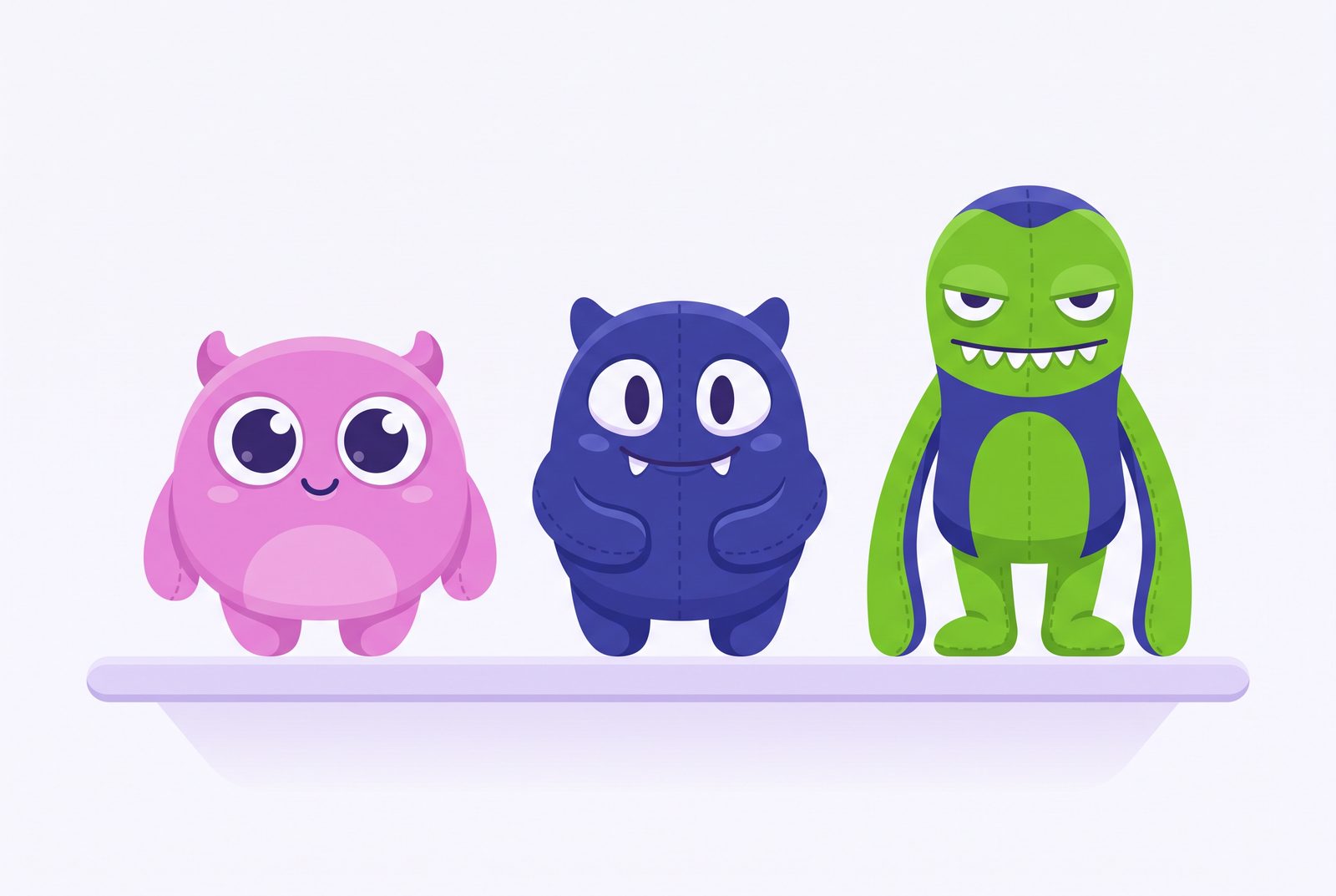
Huggy Wuggy is the furry blue monster with long arms and a mouth full of teeth from a horror video game released in 2021. In the game he is a giant mascot toy in an abandoned toy factory who chases the player. Clips from the game and fan-made songs then spread online far beyond the players themselves.
The trouble is the mismatch. Huggy Wuggy looks like a cartoon character, with bold colours and a name that sounds like a cuddle, so a 5- or 6-year-old can stumble on a video made to frighten teenagers. In early 2022, primary schools in Belfast and the PSNI in Northern Ireland, along with schools and police forces across Britain, warned parents after young pupils had watched the videos and copied scenes in the playground.
The toy itself is not dangerous: it is a fabric plush. It suits a fan who knows the game and has chosen it. If your child asks for one because a classmate talks about it, first ask what they know and what they have seen. Huggy Wuggy plush toys mostly appeal to older children who know the story and enjoy its spooky side.
From what age can a child have a scary teddy bear?
Children’s fears change as they grow, and that is normal. A century of research shows that fears become less frequent and less intense with age, and that most are passing (Gullone, 2000). Toddlers fear what is immediate and concrete: a loud bang, a stranger’s face, a fall. Imagined fears come later, from the monster under the bed to the more abstract worries of adolescence.
That gives a few pointers rather than rules. Under 3 years, stick to soft, smiling toys marked as suitable for under-threes, with no raised teeth or small parts. Between 3 and 7 years, the age of monsters under the bed, cute monsters have their place, provided your child picks them and they leave the bedroom if they cause worry. Older children often start to enjoy shivers and ghost stories. Two-faced bears and horror characters are best kept for tweens, teenagers and adults.
Your child is the best guide. If they laugh at it, play with it and put it away themselves, all is well. If they hide it, turn it to face the wall or no longer want to go to bed, it arrived too early. Safety checks stay the same whatever the style: the CE mark, the age label, the seams, as our guide to choosing a good-quality soft toy explains.
Halloween toys deserve a closer look than most. The Competition and Consumer Protection Commission (CCPC) reported in October 2025 that more than 25,000 unsafe Halloween toys, costumes and props had been recalled or withdrawn from the Irish market within a year. Its advice is simple: no CE mark, no purchase, and nothing smaller than a two-euro coin within reach of a child under 3 years.
How can you help a child who is afraid of a soft toy?
Fear of a soft toy is common, even of one that looks harmless to an adult: plastic eyes catching the light in the dark, a shadow on the wall, a toy that is simply huge. It usually fades on its own, and faster when the child feels listened to.
Taming a scary soft toy, step by step
Listen without teasing
Ask what frightens them: the eyes, the teeth, the size, or something a classmate said at school. Skip “it’s nothing” and try “I understand”.
Take it out of the bedroom
Move it to another room, or into the press with the door shut, that same evening. Sleep comes first.
Look at it in daylight
Later, if they want, bring it out in the light. Touch it in front of them and show that the teeth are fabric.
Hand over the power
Let them decide: hide it, give it a hat, invent a silly name. A monster in a bobble hat is far less frightening.
Accept a no
If they still do not want it, pass it on to an older child or put it away. Nobody has to keep it.
The guardian soft toy, against night-time monsters
The opposite trick often works for bedtime fears. A cute monster, a dragon or a plush wolf can become the guardian of the bed: it keeps watch and scares the other monsters away. Your child takes back control of the fear by handing it to an ally. Place the guardian facing the door, next to a soft night light: you give it a job, and your child too. If they grow so attached that it becomes their comforter, our article on why a comforter matters explores that bond.
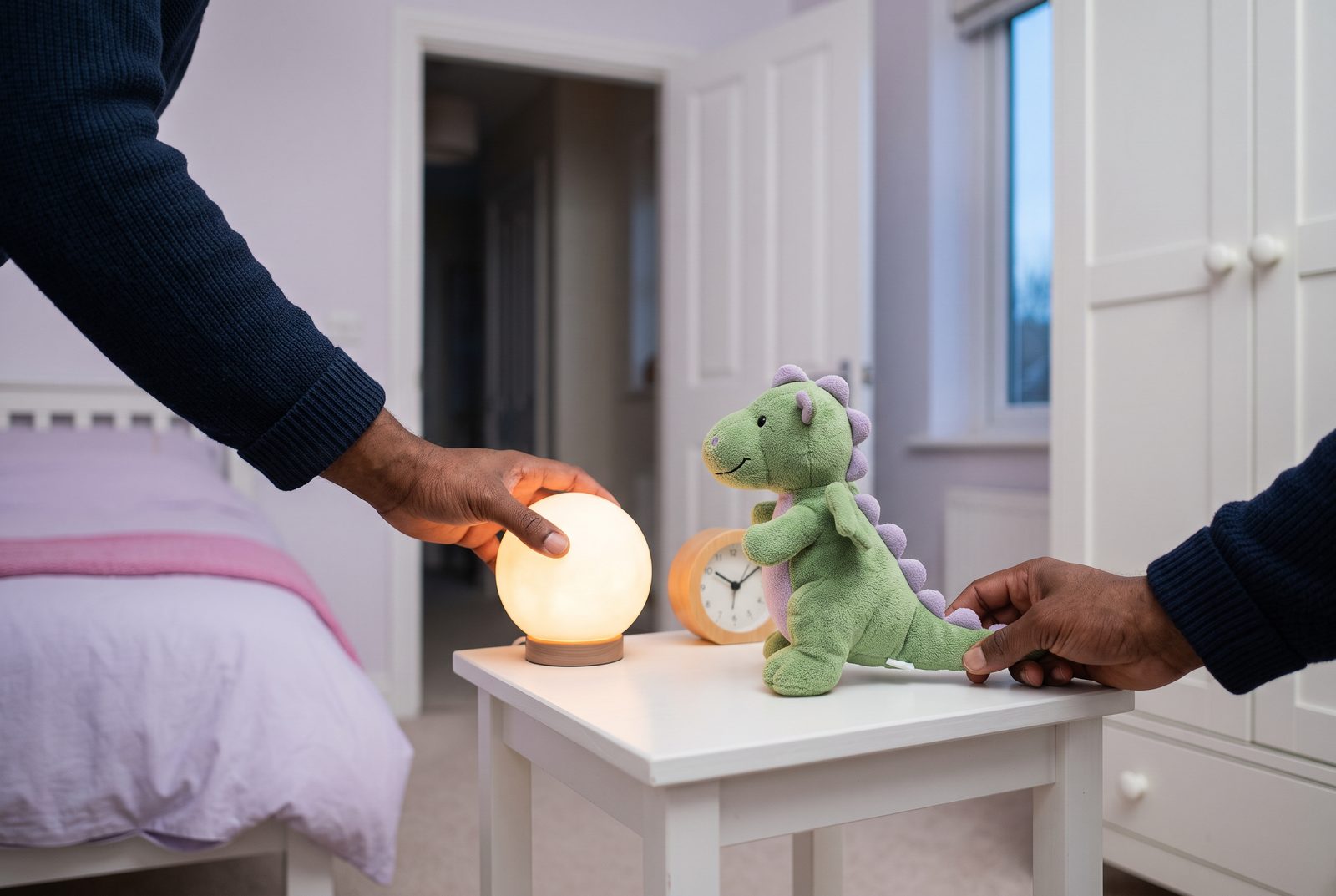
Beyond that, a reassuring bedroom comes down to small things: a dim night light, nothing with shiny eyes facing the bed, a familiar toy to hug. Our article on the best soft toy for sleep explains how to choose one.
If your child’s fears last more than 2 or 3 weeks, wake them every night or stop them going to school or to friends’ houses, speak to your GP or your public health nurse. An intense, lasting fear deserves professional advice.
Your questions about scary teddy bears
What is the scary teddy bear movie?
Two films come up most. In Toy Story 3 (2010), the villain is Lotso, a pink, strawberry-scented bear who looks like the friendliest toy in the room. Five Nights at Freddy’s, released in 2023 and based on a video game, features giant animatronic animals, a bear among them, that wake up at night. Neither is for a young child.
Who is the scary bear?
Usually Freddy Fazbear, the animatronic bear with a top hat and bow tie from the Five Nights at Freddy’s games and film. Huggy Wuggy is often lumped in with him, but he is a long-armed blue monster, not a bear. Both appeal to older fans who know the games, not to toddlers.
What is a macabre teddy bear?
A teddy that borrows from gothic or horror style on purpose: visible stitches, button eyes, a patched body, a skull motif or a crooked smile. It is made to look eerie rather than sweet, and is mostly bought by teenagers, adults and collectors. Keep one well away from a baby or a toddler who frightens easily.
Can a baby have a Halloween soft toy?
Not in the cot: the HSE advises keeping toys and teddies out of a baby’s cot. For daytime play, pick a soft, smiling toy with no raised teeth, no small glued-on parts and no loose threads, labelled as suitable from birth and carrying the CE mark. A smiling pumpkin or a round little ghost is plenty.
Sources
Andersen M.M., Schjoedt U., Price H., Rosas F.E., Scrivner C., Clasen M. (2020). Playing with fear: a field study in recreational horror. Psychological Science, 31(12), 1497-1510. DOI: 10.1177/0956797620972116
Brink K.A., Gray K., Wellman H.M. (2019). Creepiness creeps in: uncanny valley feelings are acquired in childhood. Child Development, 90(4), 1202-1214. DOI: 10.1111/cdev.12999
Glocker M.L., Langleben D.D., Ruparel K., Loughead J.W., Gur R.C., Sachser N. (2009). Baby schema in infant faces induces cuteness perception and motivation for caretaking in adults. Ethology, 115(3), 257-263. DOI: 10.1111/j.1439-0310.2008.01603.x
Gullone E. (2000). The development of normal fear: a century of research. Clinical Psychology Review, 20(4), 429-451. DOI: 10.1016/S0272-7358(99)00034-3